Track Chassis Advantages: Upgraded Terrain Passability vs Wheeled Lawn Mowers
Terrain complexity has always been a key bottleneck restricting the efficiency and safety of outdoor mowing work in landscape maintenance, orchard management, municipal slope protection, and solar farm vegetation upkeep. Traditional wheeled lawn mowers are widely used for flat and tidy lawns due to their simple structure and low cost. However, they frequently suffer from slipping, sinking, tipping over, and stuck movement on steep slopes, muddy ground, rugged terrain, and overgrown sites. Equipped with an upgraded track chassis, the remote control tracked mower effectively solves the inherent defects of wheeled mowers, delivering all-round improvements in complex terrain passability, operational stability, and scene adaptability, making it a premium solution for professional outdoor grass cutting and vegetation management.
1. Larger Ground Contact Area & Lower Ground Pressure, No Sinking on Soft Terrain
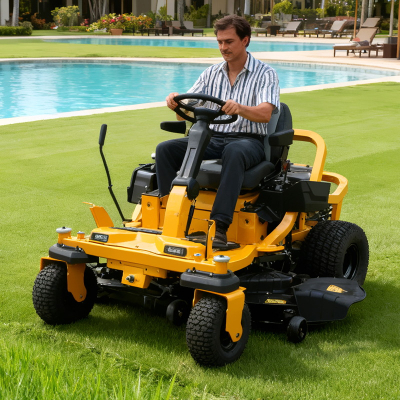
Standard wheeled lawn mowers adopt a four-point contact design with limited ground contact area. The full machine weight concentrates on four tires, resulting in high ground pressure. When operating on wet muddy fields, soft lawns, sandy slopes, and loose orchard soil, wheeled mowers are prone to tire sinking and idle slipping. This not only fails to complete normal mowing tasks but also crushes vegetation and damages the surface soil, easily causing tilting and unexpected shutdowns during operation.
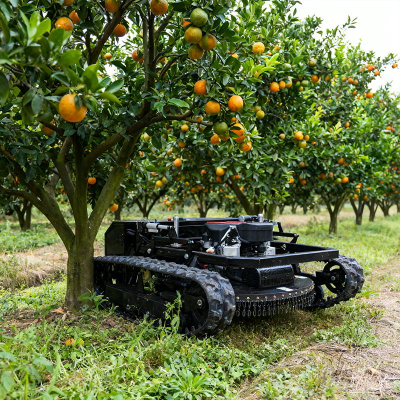
The track chassis features an extended full-contact structure, offering 3 to 4 times the ground contact area of equivalent wheeled mowers. It evenly distributes the machine’s overall weight and greatly reduces ground pressure. The crawler lawn mower can move stably on humid muddy land, waterlogged ground, and loose sandy terrain without sinking or damaging the surface. It perfectly adapts to long-term mowing tasks in loose orchard soil, wet river embankment slopes, and rainy mountain courtyards, completely solving the common pain point of poor soft-terrain performance of traditional wheeled grass cutters.
2. Stronger Ground Adhesion, Anti-Tipping Performance for Steep Slope Mowing
Steep slope mowing is one of the most dangerous and challenging scenarios in landscape maintenance, and it is also the biggest weakness of wheeled lawn mowers. Ordinary wheel tires have limited anti-slip patterns and poor lateral stability on inclined surfaces. Most wheeled mowers start slipping on slopes above 15 degrees and cannot work normally on terrain steeper than 20 degrees. Forced operation will lead to sliding, rollover, equipment damage, and even serious safety accidents for operators.
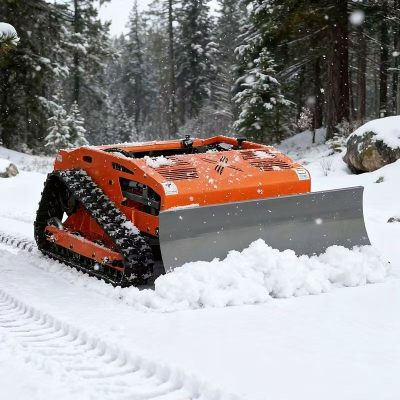
Fitted with high-density anti-slip rubber tracks with three-dimensional textured patterns, the remote control slope mower provides far stronger ground friction and adhesion than conventional wheeled models. Combined with a low-center-of-gravity chassis design, it maintains stable operation on steep slopes from 0 to 50 degrees. Whether for longitudinal climbing or horizontal slope trimming, the tracked mower runs smoothly without sliding or tipping over. Featuring wireless remote control operation, it realizes man-machine separation, eliminating all safety risks of manual slope mowing. This core advantage makes tracked mowers the preferred equipment for municipal slope maintenance, mountain orchard weeding, and hillside courtyard mowing.

3. Better Terrain Fitting Performance for Uninterrupted Operation on Rugged Ground
Most outdoor working sites feature uneven ground, bumpy surfaces, and scattered stones. Wheeled mowers with independent tire structures often experience single-wheel suspension and uneven stress on rugged terrain. This causes severe body shaking, offset movement, and uneven mowing results. Frequent stalling greatly reduces working efficiency, and long-term vibration accelerates component wear and shortens the service life of the grass mower.
The integrated flexible track chassis adapts intelligently to ground fluctuations and closely fits bumpy roads, gravel ground, and ridge slopes. It keeps the body balanced and stable without suspension or violent vibration. The all-terrain tracked mower achieves continuous and smooth movement on complex stony slopes and uneven ground, ensuring uniform mowing quality. It effectively reduces mechanical vibration loss and improves overall durability, fully meeting the demands of non-standard and harsh outdoor working conditions.
4. Superior Obstacle Crossing Capacity for Complex Field Working
Orchards, forest lands, and river embankments are covered with low weeds, dead branches, small stones, and shallow trenches. Wheeled mowers have limited chassis clearance and poor flexible routing ability. Slight obstacles will cause jamming and grass clogging, requiring manual site cleaning in advance and greatly increasing pre-operation labor costs.
Optimized with a professional chassis structure, the tracked grass cutter owns reasonable ground clearance and continuous track traveling performance, delivering greatly improved obstacle crossing and flexible routing compared with wheeled mowers. It easily passes over small stones, shallow ditches, and dense weed clusters without pre-site cleaning. Users can start mowing immediately after arrival, saving manual preparation costs and significantly improving working efficiency. It is highly suitable for large-scale field maintenance in agriculture, municipal engineering, and solar power stations.
5. Wider Application Scenarios, Breaking the Limits of Flat-Land Mowing
In summary, traditional wheeled lawn mowers are only applicable to flat and standardized lawns with extremely single application scenarios, which can no longer meet the diversified and complex outdoor vegetation maintenance needs. Benefiting from stable grounding, powerful anti-slip performance, excellent obstacle crossing, and anti-sinking capacity, the track chassis completely breaks terrain restrictions. The commercial tracked mower works efficiently on flat ground, steep slopes, muddy land, gravel terrain, and rugged mountain areas, covering private courtyards, orchards, forest farms, municipal river slopes, solar power plants, and professional landscape engineering projects.
Conclusion
As the global landscape, agriculture, and municipal maintenance industries pursue higher safety, efficiency, and refinement standards, traditional wheeled mowers can no longer adapt to complex terrain mowing requirements. As a core upgraded structure of modern outdoor mowing equipment, the track chassis achieves comprehensive breakthroughs in terrain passability, operational stability, safety performance, and scenario compatibility. It solves key industry pain points in complex terrain vegetation management, reduces manual operation risks and long-term maintenance costs, and represents the mainstream development trend of high-efficiency automated lawn mowing equipment.