How to Choose Snow Removal Equipment: 5 Key Factors Before You Buy
Winter brings significant challenges to road access, property maintenance, industrial operations, and agricultural activities. Choosing the right snow removal equipment is essential for maintaining accessible roads, reducing manual work, and keeping outdoor areas operational throughout the winter season.
However, purchasing a snow removal machine involves more than comparing engine horsepower or equipment prices. Factors such as working conditions, snow depth, removal methods, terrain, operator safety, and maintenance requirements all influence equipment performance and long-term value.
Whether you are maintaining industrial facilities, managing agricultural properties, operating a snow removal business, or sourcing machinery for commercial applications, understanding these factors can help you make a more informed purchasing decision.
In this guide, we explore five important factors to consider when choosing snow removal equipment, along with a practical look at a remote-controlled tracked snow blower and snow plow designed for professional winter maintenance.
1. Match Snow Removal Equipment to Your Working Environment
Before comparing different snow removal machines, evaluate where and how the equipment will be used.
A machine designed for clearing wide roads may not be suitable for narrow pathways, farm access lanes, or confined industrial areas. Similarly, equipment operating on flat paved surfaces may require different traction capabilities from machines working on slopes or uneven terrain.
Consider the following factors before purchasing:
· Working area: Road width, pathway dimensions, and available turning space.
· Snow conditions: Average snowfall, snow depth, and frequency of accumulation.
· Ground conditions: Ice, compacted snow, slopes, and uneven surfaces.
· Access limitations: Narrow passages, restricted entrances, and obstacles.
· Snow discharge requirements: Whether snow needs to be pushed aside or discharged away from the cleared area.
For restricted-access locations, compact snow removal equipment can offer practical advantages over larger trucks and loaders.
For example, the SAAO Remote-Controlled Tracked Snow Blower & Snow Plow measures 1,850 × 1,000 × 1,120 mm. Its compact dimensions make it suitable for evaluating applications such as farm lanes, industrial yards, pathways, facility entrances, and other relatively confined working areas.
The tracked chassis and manufacturer-rated maximum slope capability of 35° also make terrain compatibility an important consideration for customers working on sloped surfaces.
Actual operating suitability depends on snow conditions, ground friction, slope characteristics, and site safety requirements. Always evaluate the working environment before selecting equipment.
2. Choose Between a Snow Plow, Snow Blower, or Combined System
Different snow conditions require different removal methods. Understanding the difference between a snow plow and a snow blower is one of the most important steps when selecting winter maintenance equipment.
Snow Plow: Efficient Snow Pushing
A snow plow uses a blade to push accumulated snow toward the side of a road or into designated snow piles.
It is commonly considered for:
· Road and driveway clearing
· Parking areas and access roads
· Farm lanes and outdoor yards
· Facility entrances and loading areas
· Areas where snow can be piled along the roadside
A snow plow is particularly useful when snow needs to be moved out of the traffic or working area without being discharged over a longer distance.
Snow Blower: Collecting and Discharging Snow
A snow blower uses a rotating auger system to collect snow and feed it into a discharge mechanism, which moves snow away from the cleared surface.
It can be useful when:
Snow accumulation is too large to simply push aside.
Roadside space is limited.
Snow needs to be discharged away from pathways.
Repeated snowfall creates substantial snow piles.
Clearing operations require a more controlled snow discharge direction.
Why Consider a Combined Snow Removal Machine?
For professional winter maintenance, a combination of snow plowing and snow blowing can provide greater operational flexibility.
The SAAO Remote-Controlled Tracked Snow Blower & Snow Plow integrates two working attachments on one tracked platform:
· 1,000 mm snow plow: Pushes accumulated snow away from roads, pathways, and working areas.
· 800 mm snow blower: Collects and discharges snow when pushing alone is insufficient.
This two-function configuration allows operators to select the appropriate snow removal method according to the working environment and snow accumulation conditions.
For contractors and facility operators managing different types of outdoor areas, combining these functions on one machine can simplify equipment selection and winter maintenance planning.
3. Evaluate Traction, Mobility, and Terrain Performance
Snow removal equipment frequently operates on slippery, uneven, and unpredictable surfaces. Even a machine with effective snow removal attachments may struggle if its chassis cannot maintain sufficient traction.
When comparing tracked and wheeled snow removal machines, consider:
· Chassis design and drive system
· Ground contact and traction
· Performance on slippery and uneven surfaces
· Turning ability in confined spaces
· Travel speed
· Operating stability on slopes
· Equipment weight and transportation requirements
Tracked vs. Wheeled Snow Removal Equipment
Wheeled machines can be suitable for many paved surfaces and conventional road maintenance applications. However, tracked equipment may offer advantages when working on uneven ground, loose surfaces, or areas where increased ground contact is desirable.
The SAAO tracked snow removal machine features an electric track drive system with two 800 W travel motors.
Its main mobility specifications include:
| Specification | Value |
|---|---|
| Chassis | Tracked |
| Track Drive Motors | 800 W × 2 |
| Track Width | 150 mm |
| Travel Speed | 6–8 km/h |
| Operating Weight | 370 kg |
| Maximum Rated Slope | 35° |
The tracked design helps distribute the machine's weight across the contact surface and supports movement across different outdoor working conditions.
For mountain facilities, agricultural properties, industrial yards, and uneven access routes, tracked mobility is worth considering when evaluating snow removal equipment.
However, traction and stability depend on the actual ground surface, snow and ice conditions, and operating slope. A site assessment is recommended before purchase.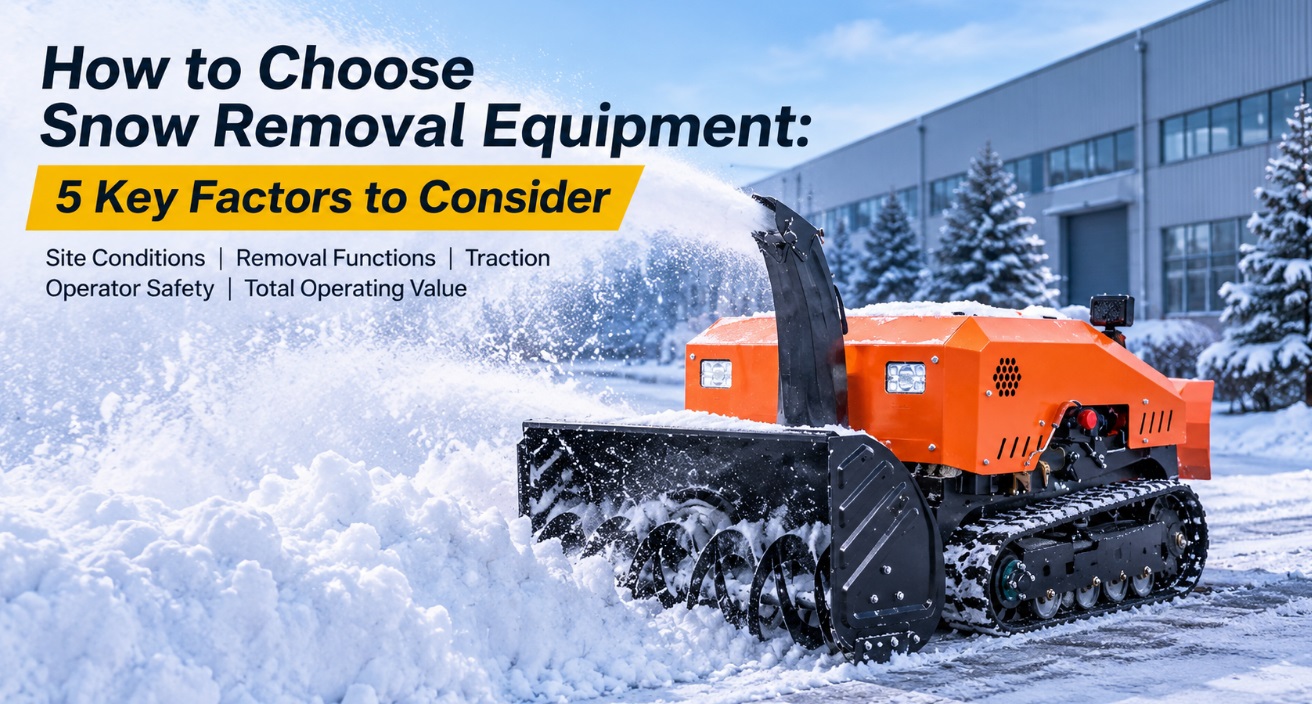
4. Prioritize Operator Safety and Remote-Controlled Operation
Winter maintenance operations can involve slippery surfaces, low temperatures, moving attachments, limited visibility, and restricted access.
In some working environments, operating a snow removal machine remotely allows the operator to control the equipment from a suitable position away from the machine.
When evaluating remote-controlled snow removal equipment, check which functions are available through the remote control.
Important functions may include:
· Engine starting and stopping
· Forward and reverse movement
· Steering
· Throttle adjustment
· Attachment lifting
· Lighting control
· Emergency stop
What Makes a Remote-Controlled Snow Removal Machine Useful?
The SAAO Remote-Controlled Tracked Snow Blower & Snow Plow is designed for remote operation, with control functions covering starting, driving, steering, attachment lifting, throttle adjustment, lights, and emergency stop.
Its manufacturer-rated remote control range is up to 500 m.
The actual operating distance may vary depending on terrain, obstacles, weather, signal interference, and surrounding conditions.
Remote-controlled operation can be particularly useful when maintaining slopes, restricted-access areas, snow-covered pathways, and locations where direct operator access is inconvenient.
However, remote operation does not eliminate workplace risks. Operators should maintain suitable visibility, establish a safe operating zone, keep people away from moving attachments and snow discharge areas, and follow applicable machinery safety procedures.
5. Compare Power, Maintenance, and Total Operating Costs
The initial purchase price is only one part of the investment in commercial snow removal equipment.
For long-term operation, buyers should also consider engine performance, electrical systems, maintenance requirements, spare parts availability, and after-sales support.
Check the Power Configuration
The SAAO remote-controlled tracked snow removal machine is equipped with:
· 16 HP diesel engine
· 48 V / 3,000 W generator
· Remote and manual starting options
This power configuration supports the machine's operating and electrical systems.
When comparing different machines, make sure the engine, generator, travel motors, and attachment systems are suitable for the intended workload.
Evaluate Maintenance and After-Sales Support
Before confirming an order, ask the supplier about:
· Recommended engine maintenance intervals
· Track drive system maintenance
· Replacement parts availability
· Snow plow blade and snow blower wear components
· Remote control system servicing
· Technical documentation and operator training
· Warranty coverage and after-sales support
· Delivery and local compliance requirements
A reliable supply of replacement parts and accessible technical support can make a significant difference during the winter operating season.
It is also worth considering the machine's position in your annual equipment maintenance plan. For equipment dealers, rental businesses, and professional contractors, matching machine configurations to different customer applications can improve equipment utilization.
Which Snow Removal Equipment Is Right for Your Application?
The best snow removal machine is not necessarily the largest or most powerful one. It is the machine that matches your working conditions, snow accumulation, terrain, and maintenance requirements.
A remote-controlled tracked snow blower and snow plow may be worth considering if your application requires:
· Compact dimensions for restricted-access working areas
· Both snow plowing and snow blowing functions
· Tracked mobility for uneven outdoor surfaces
· Remote-controlled operation
· Diesel-powered equipment for winter maintenance
· Applications across roads, farms, industrial parks, facilities, and outdoor yards
Before selecting a machine, provide your supplier with the following information:
1.Location: Country or region where the machine will operate.
2.Snow conditions: Average snowfall and expected snow depth.
3.Terrain: Flat roads, slopes, uneven ground, or icy surfaces.
4.Working area: Road width, access restrictions, and available turning space.
5.Removal requirements: Whether you need snow pushing, snow blowing, or both.
6.Operating requirements: Expected working hours and maintenance frequency.
7.Quantity: Number of machines required.
These details help determine whether the machine's configuration is appropriate for your intended application.
Conclusion: Make the Right Choice for Winter Maintenance
Choosing the right snow removal equipment requires a comprehensive understanding of the working environment and operational requirements.
Before purchasing, focus on five essential factors:
1.Working environment and site conditions
2.Snow removal functions
3.Traction and terrain performance
4.Operator safety and remote control
5.Power configuration, maintenance, and total operating costs
For professional users who need both snow pushing and snow blowing capabilities, the SAAO Remote-Controlled Tracked Snow Blower & Snow Plow combines a 1,000 mm snow plow, an 800 mm snow blower, tracked mobility, remote-controlled operation, and a 16 HP diesel engine on one compact platform.
If you are looking for a remote-controlled snow removal machine for roads, farms, industrial facilities, or restricted-access areas, contact SAAO to discuss your application requirements, machine configuration, and purchasing plans.
Contact SAAO for Product Details and a Quotation.
Frequently Asked Questions About Snow Removal Equipment
1. How do I choose snow removal equipment for a narrow road?
Start by measuring the available road width, turning space, and snow accumulation. Compact tracked snow removal equipment may be worth considering when large trucks or loaders cannot access the working area efficiently.
2. What is the difference between a snow plow and a snow blower?
A snow plow pushes accumulated snow to the side or into designated piles. A snow blower collects snow and discharges it away from the cleared surface. A combined machine offers both functions for different snow removal conditions.
3. Is a tracked snow removal machine suitable for uneven ground?
Tracked equipment provides increased ground contact compared with many conventional wheeled platforms. It can be useful on uneven or slippery surfaces, but actual suitability depends on terrain, slope, snow depth, and ground conditions.
4. What are the advantages of a remote-controlled snow blower?
Remote-controlled operation allows operators to control machine movement, steering, and supported attachment functions from a distance. This can be useful in restricted-access areas and locations where direct operator access is inconvenient.
5. What is the remote control range of the SAAO snow removal machine?
The SAAO Remote-Controlled Tracked Snow Blower & Snow Plow has a manufacturer-rated remote control range of up to 500 m. Actual range depends on terrain, obstacles, weather, signal interference, and operating conditions.
6. Can one machine both push and blow snow?
Yes. A combined snow removal machine can integrate a plow blade and a snow blower on one platform. The SAAO model features a 1,000 mm snow plow and an 800 mm snow blower, allowing users to select different snow removal methods according to site requirements.
7. Where can a remote-controlled tracked snow removal machine be used?
Potential applications include industrial parks, farm roads, agricultural properties, facility entrances, campuses, logistics yards, scenic areas, and other outdoor locations where winter snow maintenance is required.