Taming the Incline: Why Remote Control Mowers are the Strategic Choice for Steep Slope Maintenance
Mowing a flat lawn is routine; maintaining a 50-degree embankment is a high-stakes operation.
For landscaping contractors, roadside maintenance teams, and property managers, steep terrain presents a unique set of hazards: loose soil, dense overgrowth, and unpredictable traction. Relying on conventional equipment in these areas isn't just inefficient—it’s a liability.
The shift toward Remote Control (RC) slope mowers isn't about chasing gadgets; it’s about a fundamental change in operational safety and output. By decoupling the operator from the machine, these units transform dangerous, high-fatigue jobs into manageable, precise tasks.
The Reality of Slope Operations: Three Critical Pain Points
Why do standard wheeled mowers fail where the incline gets steep?
The Traction Gap: Wheeled machines rely on a small contact patch. On wet grass or loose embankments, they lose grip instantly, turning a mower into a sliding hazard.
Operator Fatigue and Risk: Manual mowing on an incline is physically grueling. Workers facing constant slip risks or heat exhaustion are less productive and more prone to accidents.
Accessibility Dead Zones: Roadside ditches, culverts, and dense orchards often lack the clearance for tractors and the safety for walk-behind units.
The RC Logic: Separating Man from Machine
The value proposition of a remote control mower is straightforward: Put the machine on the slope, and the human in the safety zone.
Tracked Mobility: "Biting" into the Terrain
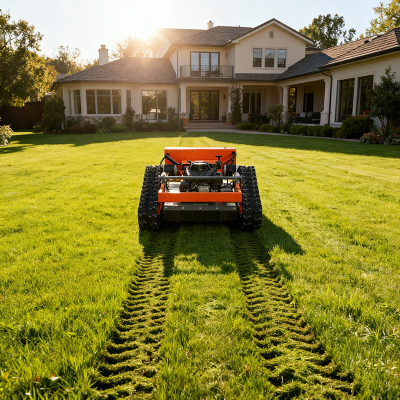
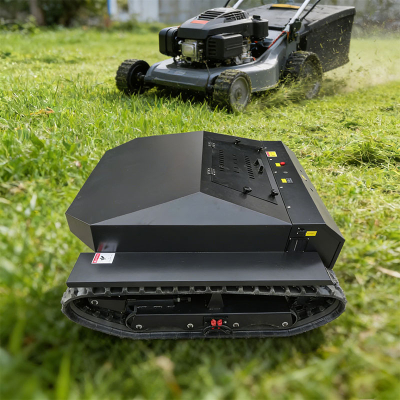
Unlike wheels, rubber tracks distribute the machine's weight over a larger surface area. This low ground pressure ensures the mower "bites" into the slope, providing the stability needed to traverse cross-slopes without sliding.
Remote Command: Enhanced Situational Awareness
Operating from a distance isn't just about comfort; it’s about perspective. An operator standing on stable ground has a 360-degree view of the terrain hazards that someone sitting on or pushing a mower might miss.
Selecting a Slope Mower: Beyond the Spec Sheet
When evaluating equipment for professional use, look past the basic marketing and focus on these field-ready metrics:
Verified Gradeability: While many claim high climbing angles, the real test is stability on wet or uneven ground. Look for machines with a low center of gravity.
Track Tension and Durability: In heavy vegetation, tracks face immense lateral stress. Industrial-grade rubber tracks are a non-negotiable for commercial work.
Cutting Width vs. Manoeuvrability: A wider deck (e.g., 600mm) covers ground faster, but the machine must remain agile enough to navigate around trees and infrastructure.
Signal Reliability: In slope work, even a half-second of latency is too much. The remote system must offer instantaneous, precise response for steering and blade height adjustments.
Field Case: Roadside Embankment Maintenance
Consider a highway contractor tasked with clearing hundreds of meters of overgrown embankment.
Traditional methods would involve a crew with string trimmers (too slow) or a tractor-mounted flail (limited by slope angle and reach). With a tracked RC mower, a single operator stands safely on the shoulder, guiding the unit across the incline. The hybrid system provides the torque to mulch thick woody brush, while the tracks ensure the unit stays glued to the grade, significantly reducing the project timeline and insurance risk.
SAAO SAG600: Engineered for the Professional Incline
For teams managing challenging terrain, the SAAO SAG600 Hybrid Remote Control Lawn Mower represents a purpose-built solution.
It features a 600mm cutting width and a verified 50° gradeability, designed specifically for areas where human access is restricted. The SAG600 utilizes a sophisticated hybrid system: a 9.5 HP gasoline engine drives the cutting deck, while a 2200W generator powers dual 800W high-torque electric motors for the tracks.
This combination ensures that the cutting power never sacrifices the driving force. With remotely adjustable cutting heights (1–12 cm), the SAG600 handles everything from fine grass to tough, neglected vegetation.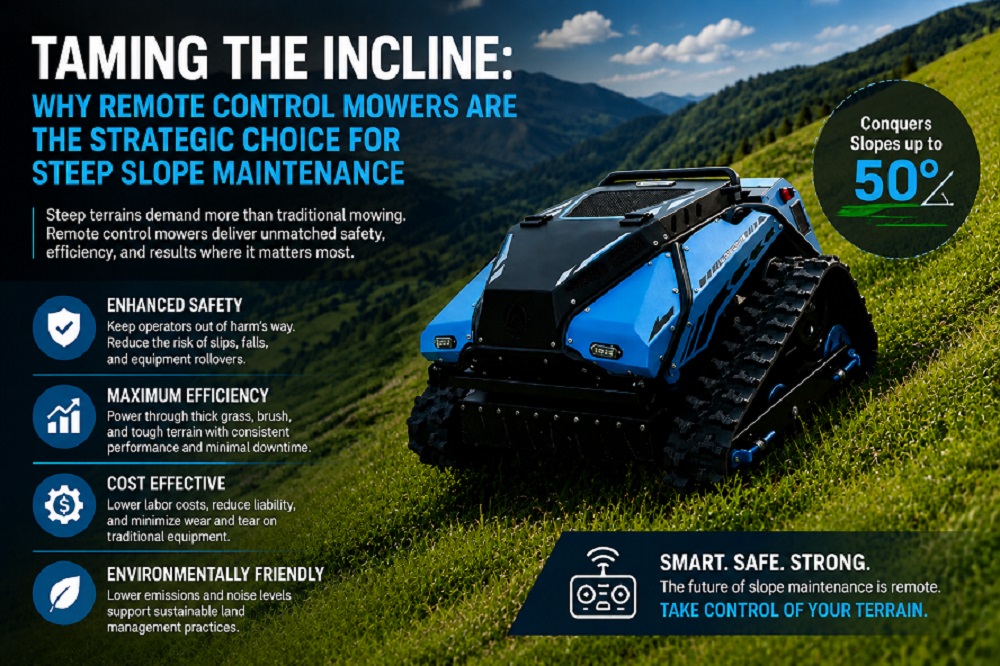
When to Make the Switch?
If your operations involve any of the following, an RC slope mower is likely the missing piece of your fleet:
Highway and railway embankments
Retention ponds and dam faces
Steep orchards or solar farm perimeters
Neglected commercial land with uneven topography
Final Thoughts
Success in slope maintenance isn't just about raw horsepower; it’s about traction, stability, and—most importantly—keeping your crew out of harm's way. The SAAO SAG600 proves that with the right technology, the most dangerous jobs in landscaping can become the most efficient.
Looking to optimize your steep-slope operations? Explore the full capabilities of the SAAO SAG600 and equip your team for the next challenge.