Spring Lawn Care Guide: 5 Steps to Revitalize Your Turf – And How a Hybrid Mower Gives You the Edge
As temperatures rise, your lawn enters its most critical growth and recovery period. Proper spring care not only repairs winter damage but also sets the stage for a lush, healthy summer. SAAO combines decades of turf management expertise with advanced hybrid remote-controlled mowers to help you work smarter, not harder.
Why Spring Maintenance Matters More Than You Think
After months of cold temperatures, snow cover, and repeated freeze-thaw cycles, your lawn is vulnerable. Soil becomes compacted, thatch layers accumulate, and bare patches appear from foot traffic, snow mold, or ice damage. If left unattended, weeds and moss will quickly colonize these weak spots, leading to thin, yellow, and uneven turf.
Spring is the only window when grass roots are actively growing while most weeds are still dormant. Timely care in early spring can reduce summer weed pressure by up to 70% and cut watering needs by nearly half. The key is a systematic approach: wake up the roots, encourage tillering, suppress weeds – and choose mowing equipment that enhances, rather than hinders, each step.
Spring mowing mistakes to avoid:
❌ Cutting too short on the first mow – scalps the crown, kills new shoots
❌ Using dull blades – tears grass, leaving ragged brown tips
❌ Mowing wet grass – clogs deck, spreads disease, compacts soil
❌ Same mowing pattern every time – grass leans, ruts form
❌ Ignoring slope safety – risk of rollover or slipping on wet inclines
5 Must-Do Steps for Spring Lawn Care
1. Clean & Rake – Clear the Way for New Growth
Start by removing all winter debris: fallen branches, dead leaves, twigs, and any remaining snow mold patches. Use a stiff plastic or leaf rake, or for larger areas, a power rake (verticutter).
Why it matters: Debris blocks sunlight and traps moisture, promoting fungal diseases. Thatch layers thicker than 1.5 cm (0.6 in) prevent water, air, and fertilizer from reaching roots.
Pro tip: If you notice a spongy feel underfoot, rent a core aerator. Core aeration removes small plugs of soil, reducing compaction and creating channels for oxygen and nutrients. For best results, aerate just before the second mowing.
2. First Mow – The Most Important Cut of the Year
Wait until new shoots reach 5–8 cm (2–3 in) before the first cut. Never remove more than one-third of the grass height in a single mowing. Cutting too low scalps the crown, stressing the grass and inviting weeds.
Recommended first-cut height: 4–6 cm (1.6–2.4 in) for cool-season grasses (fescue, ryegrass, bluegrass). For warm-season grasses (Bermuda, zoysia), wait until soil temperature reaches 15°C (60°F) and cut to 2.5–5 cm (1–2 in).
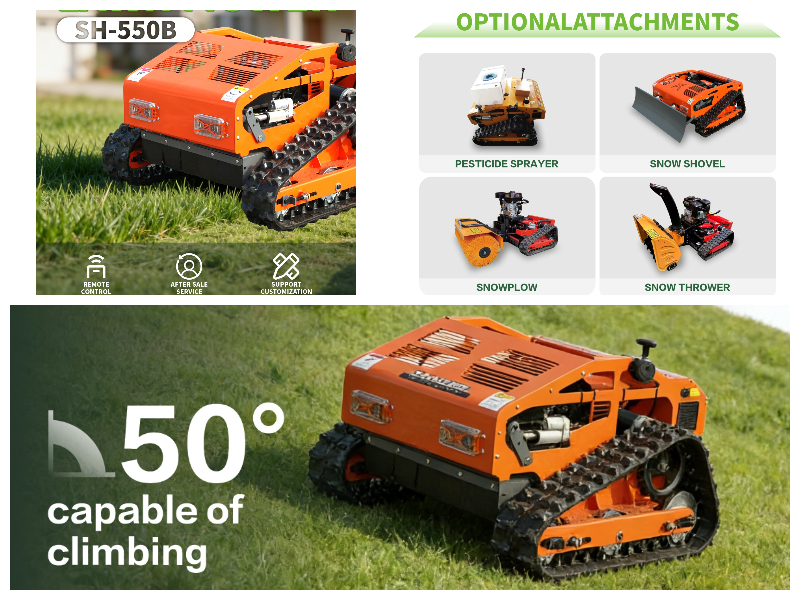
SAAO advantage: Our hybrid remote-controlled mowers (SH-550B and SH-800DL) feature electric cutting height adjustment from 1 cm to 20 cm, controlled from the remote. No stopping, no manual cranking – you can dial in the exact height while standing safely on flat ground. The rubber tracks distribute weight evenly, preventing ruts and protecting tender new shoots.

3. Overseed & Repair Bare Spots
Identify areas damaged by snow mold, dog urine, or heavy foot traffic. Loosen the top 1–2 cm of soil with a rake or cultivator. Spread grass seed matching your existing variety (use a high-quality blend for your climate). Cover with a thin layer of compost or topsoil (0.5 cm), then press down gently.
Watering schedule: Keep the area consistently moist – light watering twice daily for 10–14 days until germination. Once seedlings reach 5 cm, reduce to deep, infrequent watering.
Pro tip: Mix seed with a starter fertilizer (high phosphorus) to boost root development. Avoid using weed control products on newly seeded areas for at least 6 weeks.
4. Spring Fertilisation – Feed for Vigorous Growth
Use a slow-release, nitrogen-rich lawn fertiliser with an N-P-K ratio close to 3-1-2 (e.g., 24-8-16). Apply at the manufacturer’s recommended rate – over-fertilising burns grass and pollutes groundwater.
Timing: Apply when the lawn is dry but rain is expected within 24–48 hours, or water immediately after spreading. Early morning application reduces evaporation.
Optional: If a soil test shows acidic pH (below 6.0), apply lime at least two weeks before fertiliser. This improves nutrient availability and discourages moss.
5. Weed & Moss Control – Stop Problems Before They Start
Spring is the prime germination window for broadleaf weeds (dandelion, clover, plantain) and moss.
For weeds: Spot-treat with a selective broadleaf herbicide when weeds are small and actively growing. Avoid spraying on windy days or when rain is forecast within 6 hours.
For moss: Moss thrives in acidic, compacted, shady, or poorly drained soil. First, improve drainage and increase sunlight (prune overhanging branches). Apply a moss killer containing iron sulphate; the moss will blacken and die within 7–10 days, then rake it out.
Natural alternative: Raise your mowing height to 6–8 cm (2.5–3 in). Taller grass shades the soil, naturally suppressing weed germination and reducing moss.
Why a Hybrid Mower Is Your Best Spring Ally
Spring conditions – damp grass, uneven thawed ground, and rapid growth – challenge every mower. Traditional push mowers slip, clog, and bog down. Zero-turn riders compact wet soil. SAAO’s hybrid remote-controlled series solves these problems systematically.
| Feature | Benefit for Spring Lawn Care |
Hybrid powertrain (engine + generator) | Steady torque even in wet, heavy grass – no stalling, no belt slippage |
Rubber tracks instead of wheels | Low ground pressure – no ruts, no soil compaction, protects new roots |
500 m remote control range | Operator stays off soft spring turf – zero foot traffic damage |
Electric height adjustment (1–20 cm) | Dial in precise first-cut height (4–6 cm) without stopping |
Low noise (60–75 dB) | Mow early morning without disturbing neighbours |
Low emissions | Zero tailpipe on electric models; hybrid saves 30% fuel vs. petrol |
All-terrain ability | Climbs 50–60° slopes – no terrain limitation |
How the SAAO SH-550B & SH-800DL Excel in Spring
SH-550B (9 HP, 550 mm cutting width, 50° slope)
Ideal for residential hillsides, orchards, and medium-sized properties (up to 2 acres).
Lightweight yet powerful – easy to transport and store.
Electric start and manual backup – no pull cord frustration.
SH-800DL (16 HP, 800 mm cutting width, 60° slope)
Built for commercial use: large estates, solar farms, golf courses, and steep embankments.
41 mm widened rubber tracks grip wet, slippery slopes with zero slippage.
13.2 L fuel tank – all-day runtime between refuels.
Both models include a built-in generator (2200–2500 W) that keeps the batteries charged, ensuring unlimited runtime. You never have to stop mid-job to recharge – just refuel and continue.
Frequently Asked Questions – Spring Lawn Care
Q: Can I mow immediately after fertilising?
A: Wait 24–48 hours after granular fertiliser application, and water first. Mowing too soon can remove unabsorbed nutrients.
Q: How often should I mow in spring?
A: During peak growth (April–May), mow every 5–7 days. Never remove more than one-third of the blade height in a single cut.
Q: What should I do if my lawn has large bare patches?
A: Follow step 3 (overseeding). For very large areas (>30% of lawn), consider a full renovation: kill existing vegetation, till, level, seed, and roll.
Q: Do I need a different mower for slopes vs. flat areas?
A: Not with SAAO hybrid remote mowers. Their rubber tracks and low center of gravity handle slopes up to 60°, while still being fast and stable on flat ground.
Q: Is hybrid mowing really cheaper than petrol?
A: Yes. Based on 100 hours of annual use, a SAAO hybrid consumes 30% less fuel than a comparable petrol mower and eliminates belt replacements. Over five years, total ownership cost is 20–25% lower.
Get Started Today
Don’t let another spring slip away with inefficient, back-breaking lawn care. Give your turf the fresh start it deserves – and save hours of hard work with SAAO’s intelligent hybrid technology.