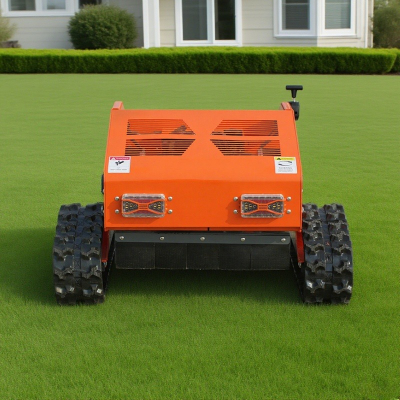
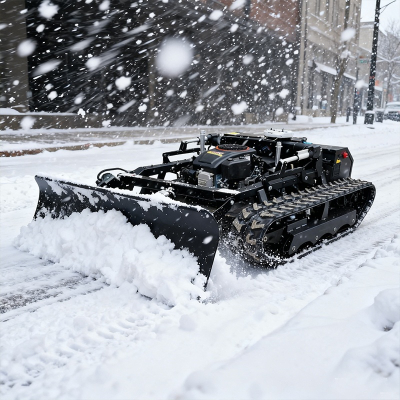
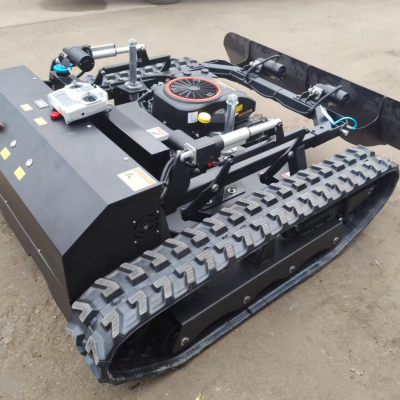
Remote Control Mowers for Steep Slopes: A Safer and More Efficient Choice for Commercial Landscaping
Commercial landscaping is becoming increasingly demanding. Contractors and property maintenance teams are often required to manage steep slopes, overgrown grass, rough terrain, roadside vegetation, orchards and other areas where conventional lawn mowers are difficult or unsafe to operate.
For these applications, a remote control mower can provide a practical alternative to traditional ride-on and walk-behind equipment. By separating the operator from the machine, remote operation allows professionals to work from a safer position while maintaining mowing performance on challenging terrain.
For landscaping contractors, municipalities, orchard operators and other professional users, the question is no longer simply which mower can cut grass. It is which machine can deliver reliable productivity, easier operation and safer performance across demanding job sites.
Why Are More Commercial Operators Considering Remote Control Mowers?
Traditional ride-on mowers remain effective on open, relatively flat areas. However, their advantages become less obvious when the job involves steep slopes, uneven ground, obstacles or areas that are difficult to access.
A remote control mower changes the way these jobs are approached.
Instead of sitting directly on the machine, the operator controls the mower remotely and can observe its working area from a safer location. This is particularly useful when mowing embankments, drainage areas, roadside slopes, orchards and other terrain where machine stability and operator positioning are major concerns.
For professional contractors, this can also make it easier to assign one trained operator to different tasks without requiring the operator to remain physically on the machine throughout the job.
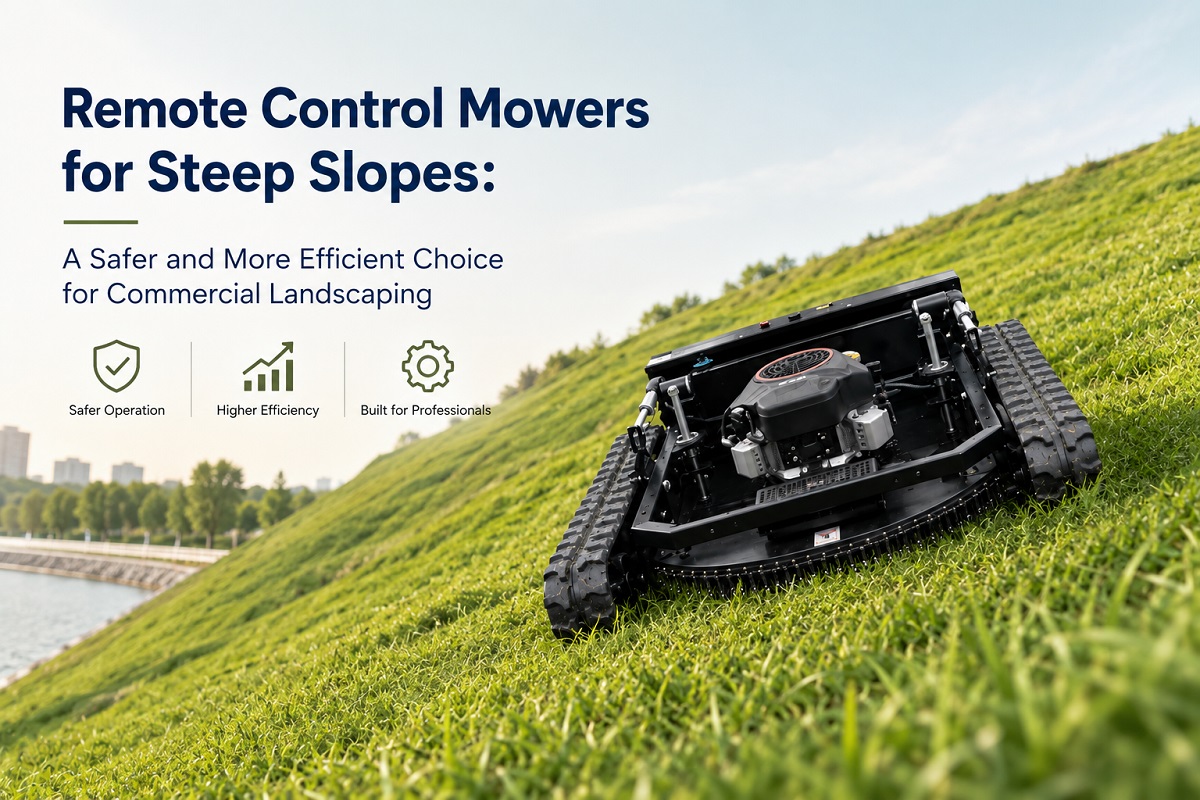
Remote Control Mowers for Steep Slopes
Steep terrain is one of the most challenging applications in commercial mowing.
A conventional ride-on mower may become difficult to control as the slope increases. Traction, stability, visibility and operator positioning can all become concerns, particularly when the surface is uneven, wet or covered with tall vegetation.
A remote control slope mower is designed specifically around these challenges.
Tracked drive systems provide a larger contact area with the ground than conventional tires, helping the machine maintain traction across uneven surfaces. A low-profile design and carefully positioned components can also contribute to greater stability when working across slopes.
Depending on the machine configuration and terrain conditions, professional remote-controlled mowers can be designed to operate on significantly steeper slopes than conventional ride-on equipment.
For contractors who regularly receive slope mowing projects, this capability can open up applications that would otherwise require additional manpower or specialized equipment.
Operator Safety: Keeping People Away From Difficult Terrain
Safety is one of the strongest reasons to consider remote-controlled mowing equipment.
When an operator is seated on a ride-on mower, the person remains exposed to the machine's operating environment. On steep or uneven terrain, a loss of traction or machine stability can create a serious safety concern.
With remote operation, the operator can remain away from the mower while maintaining direct control of the machine.
This does not eliminate every job-site risk. Operators still need proper training, suitable working procedures and an appropriate assessment of terrain, weather and machine limitations. However, moving the operator away from the machine can significantly change the risk profile of difficult mowing applications.
For commercial landscaping companies, this is particularly valuable when working around steep embankments, ditches, roadside areas or other locations where conventional mowing methods are difficult to manage safely.
Reduce Labor Pressure Without Sacrificing Productivity
Labor availability and operating costs are major concerns for landscaping contractors.
Traditional mowing operations can become labor-intensive when a job requires additional personnel for safety observation, difficult terrain or manual trimming around obstacles.
A professional remote control mower can help simplify certain operations by allowing one trained operator to control the machine remotely while maintaining visibility of the working area.
The actual labor savings will depend on the machine, terrain, mowing conditions and workflow. However, reducing unnecessary manual work can improve how a landscaping company allocates its workforce.
Instead of measuring productivity only by cutting width, fleet managers should consider the complete operating process:
· How many workers are required?
· How difficult is the terrain?
· How frequently does the machine need to be repositioned?
· How much time is spent on manual trimming?
· Can the machine work in areas where conventional equipment cannot?
· How much operator fatigue is created during a full working day?
These factors have a direct impact on the practical value of commercial mowing equipment.
Where Can Commercial Remote Control Mowers Be Used?
Remote-controlled mowing equipment is not limited to traditional lawns.
Its ability to operate on difficult terrain makes it suitable for a variety of professional applications.
Commercial Landscaping
Landscaping contractors can use remote mowers for large properties, slopes, parks, green spaces and areas with uneven ground.
The operator can control the machine from a safe position while maintaining a clear view of the mowing area.
Roadside and Embankment Maintenance
Roadside vegetation and embankments can be difficult to maintain with conventional ride-on equipment.
A tracked remote mower can provide a more flexible solution for vegetation management in areas where access and slope angle are major considerations.
Orchards and Agricultural Land
Orchards often combine uneven terrain, narrow working areas and vegetation that requires regular management.
Depending on the machine width and configuration, remote-controlled mowers can be adapted for agricultural environments where maneuverability and ground traction are important.
Municipal and Public-Space Maintenance
Municipal maintenance teams may need to manage parks, drainage areas, public green spaces and difficult-to-access vegetation.
Remote mowing technology can provide another option for maintaining these areas while keeping operators away from challenging terrain.
Solar Farms and Large Properties
Large solar farms and commercial properties require regular vegetation management.
A suitable low-profile or compact remote mower can help maintain grass and vegetation around infrastructure while reducing the need for workers to operate machinery directly in difficult areas.
Remote Control Mower vs. Ride-On Mower: Which Is Better?
There is no single mower that is best for every application.
Ride-on mowers remain an efficient choice for large, open and relatively flat areas. Walk-behind mowers can also be practical for smaller properties and detailed landscaping work.
However, when the job involves steep slopes, rough terrain or difficult access, a remote-controlled mower can offer important advantages.
| Feature | Remote Control Mower | Ride-On Mower | Walk-Behind Mower |
|---|---|---|---|
| Steep-slope capability | High, depending on model and conditions | Limited by machine design and safety requirements | Depends heavily on terrain and operator |
| Operator position | Away from machine | Seated on machine | Walking behind machine |
| Difficult terrain | Excellent for suitable models | More limited | Physically demanding |
| Labor efficiency | High for suitable applications | Good on conventional terrain | Lower for large or difficult areas |
| Operator fatigue | Lower during extended remote operation | Higher on demanding terrain | Higher |
| Large open areas | Suitable | Excellent | Less efficient |
| Rough or uneven slopes | Strong advantage | More challenging | Physically demanding |
The best choice depends on the job rather than simply the machine category.
For contractors handling a mixture of flat lawns and steep terrain, a remote-controlled mower can complement existing ride-on equipment rather than completely replace it.
What Should You Look for When Buying a Remote Control Mower?
Choosing the right machine requires more than comparing horsepower and cutting width.
1. Slope Capability
If steep-slope mowing is a major part of your business, check the manufacturer's rated gradeability and understand the conditions under which that rating applies.
Surface conditions, moisture, vegetation, soil type and machine configuration can all affect actual performance.
2. Track and Traction System
For difficult terrain, traction is critical.
Heavy-duty rubber tracks and a suitable drive system can help maintain ground contact on uneven surfaces and reduce the risk of slipping.
3. Cutting System
Different jobs require different cutting systems.
Flail mowing is often useful for dense grass, weeds and heavier vegetation, while other cutting configurations may be better suited to regular lawn maintenance.
Before purchasing, consider the vegetation you normally encounter rather than selecting equipment based solely on cutting width.
4. Remote-Control Range and Control Precision
A reliable remote-control system is essential.
Operators should be able to control forward and reverse movement, steering, cutting functions and other key operations accurately while maintaining a clear view of the machine.
5. Engine and Power System
For professional equipment, engine reliability is critical because downtime directly affects project schedules.
Depending on the model and market, engines from established manufacturers such as Kohler, Loncin or Cummins can provide different combinations of power, reliability and serviceability.
For export buyers, engine emissions certification and local regulatory requirements should also be confirmed before purchase.
6. Serviceability and Spare Parts
A machine that is easy to maintain can reduce downtime over its working life.
Before purchasing, ask about:
· Spare parts availability
· Engine service
· Track replacement
· Hydraulic components
· Electrical components
· Technical support
· Warranty coverage
For professional fleets, after-sales support should be considered part of the total equipment cost.
Why Tracked Remote Mowers Are Valuable for Professional Fleets
For companies managing multiple properties or large areas, equipment utilization is just as important as machine performance.
A tracked remote control mower can become a specialized machine within a broader fleet.
For example, a contractor could use conventional ride-on mowers for large flat lawns while assigning a remote-controlled slope mower to embankments, rough terrain and areas with restricted access.
This approach allows each machine to perform the type of work it is best suited for.
Instead of replacing an entire fleet, companies can gradually introduce remote mowing equipment into existing operations where it provides the greatest operational value.
SH-800DL: Built for Demanding Commercial Mowing
The SAAO SH-800DL is designed for professional mowing applications where terrain, vegetation and operator safety are major considerations.
Its remote-control configuration allows the operator to control the mower from a distance rather than remaining on the machine during operation.
The tracked platform is designed to provide strong ground contact on uneven terrain, while the machine's heavy-duty construction supports demanding commercial applications.
For landscaping contractors, property maintenance companies, agricultural operators and other professional users, the SH-800DL can be used for applications such as:
· Steep-slope mowing
· Tall grass and weed management
· Rough-terrain vegetation maintenance
· Commercial landscaping
· Orchard maintenance
· Embankment vegetation control
· Large-property maintenance
The right configuration ultimately depends on the working environment, vegetation type and required productivity.
Is a Remote Control Mower Worth the Investment?
For a small landscaping company, purchasing new equipment requires a careful calculation.
The machine's purchase price is only one part of the investment. A more useful evaluation should consider the total operating cost over time.
Consider:
Purchase Cost + Labor + Fuel/Energy + Maintenance + Downtime + Safety Considerations + Machine Utilization
A remote-controlled mower can become particularly attractive when a company regularly receives jobs involving steep slopes, difficult terrain or heavy vegetation.
If the machine allows a contractor to complete work that would otherwise require additional labor or specialized equipment, its value can extend beyond simple mowing productivity.
The business case should therefore be evaluated based on actual job conditions and expected annual utilization rather than a generic ROI percentage.
Frequently Asked Questions About Remote Control Mowers
Are remote control mowers suitable for commercial landscaping?
Yes. Professional remote-controlled mowers are designed for applications such as commercial landscaping, slope maintenance, roadside vegetation control, orchards and large-property maintenance.
The appropriate model depends on terrain, vegetation, required cutting width and working conditions.
Are remote control mowers difficult to operate?
Modern remote-control systems are designed around intuitive controls. Operators still require proper training, particularly when working on steep slopes or around obstacles.
The learning period will vary according to the machine and operator experience.
Can remote control mowers work on wet or muddy slopes?
Tracked systems can provide strong traction on uneven terrain, but no mower should be assumed to perform safely under every surface condition.
Wet soil, mud, loose ground and heavy rain can significantly affect traction and stability. Operators should always follow the manufacturer's operating limits.
Are remote control mowers only for steep slopes?
No.
Although slope mowing is one of their strongest applications, remote-controlled mowers can also be used for tall grass, brush management, orchards, roadside vegetation, parks and large commercial properties.
Should a landscaping company replace its ride-on mowers with remote-controlled equipment?
Not necessarily.
For many professional operators, the most practical approach is to use remote-controlled equipment alongside conventional machines.
Ride-on mowers remain highly productive on large, flat areas, while remote-controlled machines can take on difficult terrain where conventional equipment is less suitable.
The Future of Commercial Mowing Is More Flexible
The development of remote-controlled mowing technology is changing how professional operators approach difficult terrain.
The biggest advantage is not simply that a mower can be controlled remotely. It is the combination of operator separation, terrain capability, traction, productivity and flexible fleet deployment.
For commercial landscaping contractors, orchard operators and property maintenance teams, the right remote mower can help turn difficult mowing jobs into manageable operations.
Rather than asking whether remote-controlled equipment can replace every conventional mower, a better question is:
Where can remote mowing technology create the greatest operational advantage for your business?
For companies working regularly on steep slopes, rough terrain and challenging vegetation, that answer may already be clear.
Looking for a Remote Control Mower for Commercial Use?
SAAO provides professional remote-controlled mowing equipment for commercial landscaping, slope mowing, agricultural maintenance and difficult-terrain vegetation management.
Tell us about your terrain, slope angle, vegetation type, required cutting width and expected working area, and our team can recommend a suitable mower configuration for your application.