Remote Control Lawn Mower Supplier: A Complete Buying Checklist
Purchasing a remote-control lawn mower represents a major investment, especially for commercial use in municipal landscaping, golf course maintenance, large agricultural properties, vineyards, and highway slope maintenance. The right machine can transform operational efficiency, eliminate on-site safety risks, and cut long-term labor costs, while a poor choice can result in frequent downtime, exorbitant repair bills, missed project deadlines, and regulatory non-compliance fines.
Success depends not only on the machine’s on-paper specifications but also on the reliability, technical expertise, and long-term support of your supplier. The wrong partner can quickly turn a promising productivity upgrade into a costly logistical nightmare, with delayed shipments, unresponsive support, and machines that fail to perform in real-world conditions.
This guide breaks down the critical factors you must verify before signing a contract, turning a complex, high-stakes decision into a clear, actionable due diligence framework to protect your investment.
1. Technical & Compliance Checklist (Beyond Basic Brochure Specs)
A supplier’s marketing brochure only tells a fraction of the story. True due diligence requires verifying real-world performance, component quality, and full regulatory compliance for your target market.
Core Performance Validation
Don’t rely solely on listed engine power (e.g., 7.5HP) or cutting width (e.g., 550mm). These metrics mean nothing without real-world proof.
Request independent test data or third-party certified reports for:
·Actual runtime under continuous working load (not just idle time)
·Verified slope-climbing performance (e.g., 50°) on wet, loose, or uneven terrain
·Cutting quality in thick, wet, overgrown, or uneven grass conditions
·Noise and vibration levels for operator comfort and regulatory compliance
Professional, reputable suppliers will have this data readily available and be transparent about test conditions.
Battery & Electrical System (For Electric / Hybrid Models)
The battery is the heart of electric/hybrid mowers, directly impacting performance, lifespan, and safety. Confirm:
Safety Certifications: UN38.3 (critical for international shipping safety), CE, UL, or other globally recognized safety standards
Cell Quality & Warranty: Branded, high-grade lithium cells (avoid unbranded generic cells) with clear, written warranty terms (e.g., 2 years or 500 charge cycles, with coverage for capacity degradation)
Charger Design: Smart, multi-stage charging systems that protect battery health, prevent overcharging, and extend overall lifespan
Waterproof & Dustproof Rating: IP rating for the battery pack and electrical system to ensure durability in outdoor, wet conditions
Market-Specific Regulatory Compliance
This is non-negotiable. Non-compliant machines can be seized at customs, banned from operation, or result in heavy fines.
Europe: Valid CE certification + full Declaration of Conformity (DoC), plus compliance with EU machinery directives
North America: EPA emissions certification (for engine models), CARB approval (for California), and applicable UL electrical safety standards
Radio Controls: FCC certification (US) / RED certification (EU) for legal remote operation, to avoid interference with local communication frequencies
Additional Regional Requirements: Verify compliance with local noise, emissions, and safety standards for your specific country or region

2. Manufacturing & Quality Assurance
A factory’s capabilities, quality control processes, and production infrastructure directly determine the product’s durability, consistency, and on-time delivery reliability.
Rigorous Quality Control (QC) Process
Ask for a detailed, step-by-step QC protocol:
·In-line inspections during production to catch defects early
·Full performance testing (slope climbing, cutting, remote control range) for every unit before shipping
·Pre-shipment durability and stress testing to ensure machines arrive in working order
Trusted suppliers will clearly explain their multi-stage quality system and welcome factory audits.
Production Capacity & Lead Time Realism
Confirm the supplier can handle your order volume (including bulk orders for fleet purchases) and deliver on time, even during peak seasons.
Vague, overly optimistic timelines or excuses for delays are major red flags. Insist on a written, realistic production schedule with clear milestones.
Verify their ability to scale production for future orders as your business grows.
Customization & OEM/ODM Support
If you need modifications (custom paint, specialized attachments, application-specific adjustments, or private labeling), confirm the supplier has an in-house engineering team to collaborate on solutions.
A strong, capable partner will work with you to tailor machines to your unique operational needs, rather than only offering one-size-fits-all off-the-shelf products.
Ask for examples of past custom projects to validate their engineering expertise.
3. After-Sales Support & Logistics Framework
Your partnership with a supplier truly begins after the machine is delivered. Long-term value is defined by their support structure, not just the upfront sale.
Warranty Transparency & Coverage
Review the full warranty terms in detail:
·What parts and labor are covered (e.g., engine, battery, tracks, electrical components)
·Exclusions (e.g., wear-and-tear parts, misuse, improper maintenance)
·Claim procedures and response times for warranty issues
·Whether service is return-to-factory, or if they have local service partners in your region
Avoid suppliers with vague, one-size-fits-all warranty terms that exclude critical components.
Technical & Spare Parts Support
Confirm the supplier provides comprehensive, easy-to-understand English manuals, wiring diagrams, and step-by-step instructional videos for maintenance and troubleshooting.
Verify their spare parts policy: do they stock critical components (e.g., batteries, blades, tracks) locally or at the factory? What are the standard lead times for spare parts shipments?
Ask about access to 24/7 technical support for urgent operational issues.
Safe & Compliant International Shipping
Remote-controlled mowers with lithium batteries are classified as Dangerous Goods (DG) for international transport. Your supplier must have expert logistics knowledge to avoid shipping delays, fines, or seized cargo.
Provide certified UN38.3 battery test reports and MSDS (Material Safety Data Sheet) for all battery-powered units
Use fumigation-free, reinforced wooden crates engineered for heavy machinery to prevent transit damage
Prepare all required shipping documents: DG declaration, commercial invoice, packing list, and any country-specific import permits
Offer reliable, trackable shipping options with insurance for high-value equipment
4. Supplier Reputation & Long-Term Due Diligence
Trust, but verify. A supplier’s track record, industry experience, and business legitimacy are critical to a successful long-term partnership.
Verified Case Studies & Client References
Ask for specific, documented case studies of projects similar to yours (e.g., golf course maintenance, municipal slope mowing, large-scale agricultural operations).
Request contact information for existing clients in your industry (with their permission) to get first-hand feedback on product performance and supplier support.
Business Legitimacy & Factory Audits
Validate the supplier’s business legitimacy: active business license, tax registration, and factory ownership (avoid middlemen posing as manufacturers).
Verify third-party factory audits, such as ISO 9001 (quality management system), CE, or other international quality certifications.
Confirm how long they have specialized in remote-control lawn mowers (avoid generalist manufacturers with limited industry expertise).
Communication & Professionalism
Your interactions during the sales process are a direct preview of future support. Evaluate:
·Responsiveness to technical questions and quote requests
·Transparency about lead times, costs, and product limitations
·Technical expertise to answer detailed questions about performance, compliance, and maintenance
Suppliers that are unresponsive, evasive, or pushy during sales will likely be unresponsive after the sale.
Conclusion: Choose a Partner, Not Just a Product
Selecting a remote-control lawn mower supplier is not just a one-time purchase—it’s choosing a long-term operational partner that will impact your business for years to come. The lowest upfront price often leads to the highest long-term costs, from costly repairs and unplanned downtime to poor support and regulatory fines.
By rigorously verifying technical compliance, manufacturing quality, after-sales service, and company reputation, you mitigate risk and invest in a solution that will deliver reliable, consistent productivity for years.
Ready to Work With a Supplier That Checks Every Box?
SAAO designs its entire operation around these core principles:
✅ Durable, performance-engineered remote-control mowers with third-party verified performance data
✅ Full global regulatory compliance (CE, EPA, UN38.3, FCC/RED) for every market
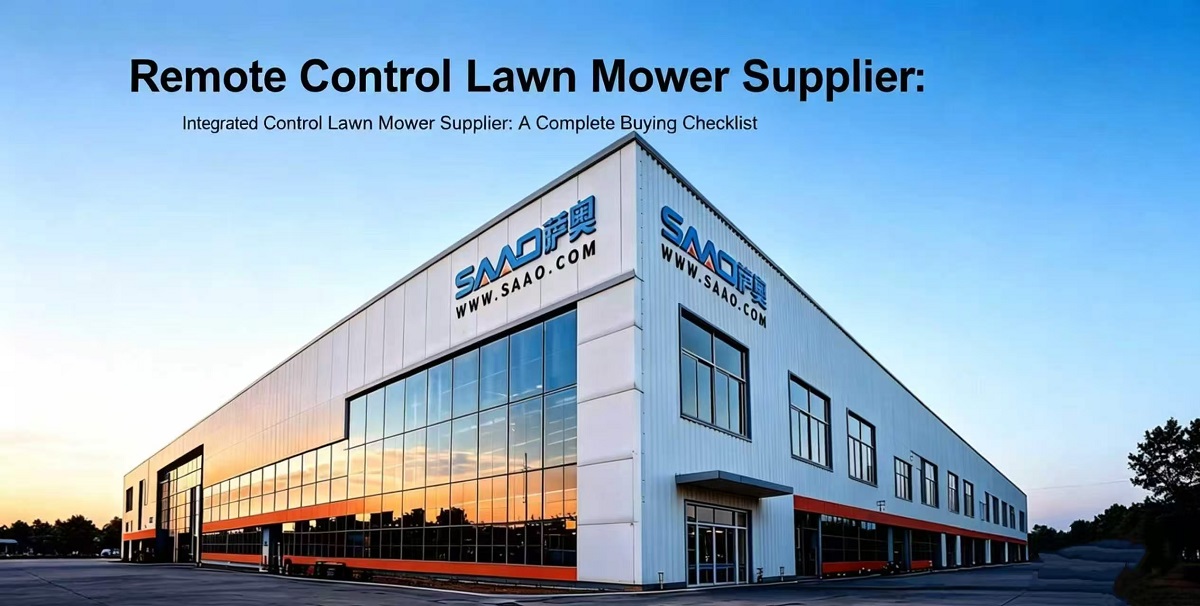
✅ Rigorous multi-stage quality control and 50,000㎡ in-house manufacturing facility
✅ Comprehensive global after-sales support, 2-year product warranties, and fast spare parts delivery
✅ Custom OEM/ODM solutions tailored to your unique operational needs
We welcome you to put us to the test with every question on this checklist. Contact us today for a transparent, detailed consultation and a professional proposal tailored to your exact business needs.