How to Choose a Remote Control Lawn Mower for Commercial Use
Choosing a remote control lawn mower for commercial use requires more than comparing engine power or cutting width. Terrain, vegetation type, mowing efficiency, remote-control range, maintenance requirements, and after-sales support all affect whether a machine is suitable for a particular job.
For landscaping contractors, grounds maintenance companies, orchard operators, and equipment distributors, the right mower should match the working environment while offering practical operation and manageable maintenance.
This guide explains the key factors to consider when selecting a remote control lawn mower for professional grass maintenance and vegetation management.
1. Evaluate the Terrain and Slope Requirements
Terrain should be one of the first considerations when choosing a remote control lawn mower. Flat lawns, uneven fields, orchard rows, roadside embankments, and inclined grass areas present different operating challenges.
For relatively flat and open areas, cutting width and working efficiency may be the main priorities. Uneven ground and sloping terrain require closer attention to traction, ground contact, machine stability, and the manufacturer's rated slope capability.
Tracked mowers can provide continuous ground contact across uneven outdoor surfaces. However, the suitability of any machine for a slope depends on ground firmness, grass conditions, moisture, side-slope angle, and operating practices.
Before purchasing, confirm the machine's rated slope capability and any restrictions on operating direction or ground conditions. Do not rely on the maximum slope rating alone when assessing job-site suitability.
2. Choose the Right Cutting Width and Working Efficiency
Cutting width determines how much grass a mower can cover in one pass. A wider cutting deck can reduce repeated travel across large, open areas, while a more compact machine may be easier to maneuver around trees, narrow passages, and landscaped obstacles.
Working efficiency is another important specification, but the published figure should be treated as a reference rather than a guaranteed daily output. Actual productivity depends on grass density, terrain, turning frequency, cutting height, operator experience, and site layout.
When comparing models, consider:
· Cutting width: Match the cutting path to the size and layout of the working area.
· Rated working efficiency: Use the manufacturer's figure as a starting point for estimating productivity.
· Travel speed: Consider how quickly the mower can move between mowing sections.
· Operating conditions: Allow for turning, repositioning, obstacles, and routine checks.
For example, the SAAO SAT-800A is a remote-controlled tracked lawn mower with an 800 mm cutting width and a stated working efficiency of up to 4,200 m²/h. These specifications make it worth considering for large grass-maintenance areas where the terrain and vegetation are suitable for the machine.
3. Match the Cutting System to the Vegetation
Not all mowing jobs involve the same type of vegetation. Regularly maintained grass requires different cutting performance from tall grass, dense weeds, or tougher overgrowth.
When selecting a mower, consider the following factors:
· Grass height and density: Determine whether the machine is intended for routine lawn maintenance or heavier vegetation management.
· Cutting mechanism: Check the blade or cutting-system design and its intended applications.
· Cutting height adjustment: Confirm that the available range matches the required finish and vegetation conditions.
· Obstacle protection: Ask how the cutting system responds to occasional contact with hard objects and what maintenance is required.
The SAT-800A provides an adjustable cutting height of 2–18 cm, allowing the mowing setup to be adjusted for different grass-maintenance requirements. Buyers should also confirm that the cutting system is appropriate for the vegetation found at their sites.
4. Consider Tracked Mobility and Machine Dimensions
The undercarriage affects how a remote control lawn mower moves across outdoor surfaces. Rubber tracks are commonly considered for uneven grass, inclined ground, and other areas where continuous ground contact is important.
However, tracked mobility alone does not guarantee safe operation on every surface. Buyers should assess traction, ground conditions, turning space, transport arrangements, and the manufacturer's operating restrictions.
Machine dimensions also matter. A compact footprint can simplify loading, transport planning, and movement through organized outdoor areas, although the required transport vehicle and loading equipment must still be checked against the machine's weight and dimensions.
The SAT-800A measures 1,391 × 1,355 × 684 mm and has a bare-unit weight of approximately 410 kg. These figures help buyers assess transport requirements and determine whether the machine can access the intended work areas.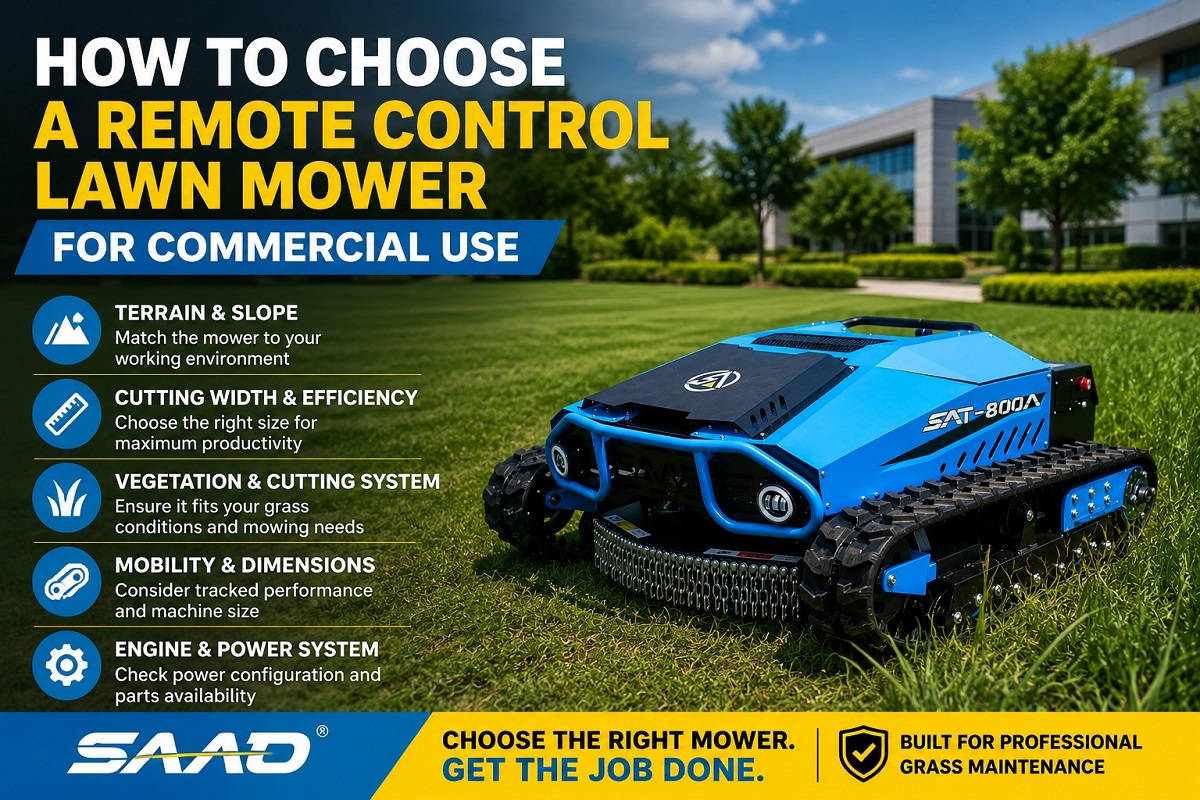
5. Check the Engine, Electrical System, and Power Configuration
A remote control lawn mower may combine an engine-driven cutting or travel system with electrical components for remote operation and other machine functions. Understanding the complete power configuration is important when comparing models.
Check the following before placing an order:
· Engine manufacturer, model, and rated output
· Starting method and routine service requirements
· Electrical-system voltage and battery configuration
· Onboard power-generation arrangements, where applicable
· Availability of replacement parts and technical support
The SAT-800A uses a 9.5 HP LONCIN 452 four-stroke gasoline engine in a hybrid gas-electric configuration. Buyers should confirm the final electrical and battery specifications for the selected machine, together with the applicable engine documentation and compliance requirements for their destination market.
6. Select a Practical Remote-Control Range
Remote-control range affects how far the operator can stand from the machine while controlling it. The appropriate range depends on the size of the site, visibility, obstacles, terrain, and working procedures.
A longer advertised range does not necessarily mean the same distance will be achieved under every field condition. Buildings, vegetation, interference, and other environmental factors may affect actual performance.
When comparing remote systems, check:
· Available control-range configurations
· Supported functions, including travel, speed, throttle, starting, and stopping
· Emergency-stop arrangements and operating instructions
· Visibility of the machine and cutting path from the operating position
The SAT-800A may be configured with a 200 m or 500 m remote-control range, depending on the selected specification. Confirm the required configuration before ordering.
7. Review Maintenance, Parts Availability, and After-Sales Support
A commercial mower should be evaluated not only by its purchase price but also by the maintenance and support required throughout its service life.
Before choosing a supplier, ask about routine maintenance intervals, blade replacement, track inspection, engine servicing, electrical-system troubleshooting, and the availability of commonly required spare parts.
It is also important to confirm the warranty in writing. Check the coverage period, exclusions, service procedures, parts responsibilities, and warranty start date rather than relying on a general warranty statement.
For equipment distributors and professional operators, access to technical documentation and responsive supplier support can also simplify machine commissioning, maintenance planning, and customer service.
8. Verify Certification and Customization Requirements
Certification and engine-emissions requirements vary by destination market and final machine configuration. Buyers should confirm which documents apply to the selected engine and complete machine before placing an order.
If the mower will be sold under a distributor's brand or adapted for a specific market, discuss customization options early in the purchasing process.
Depending on the available configuration, OEM/ODM discussions may cover branding, color, packaging, engine selection, remote-control range, electrical-system details, and other agreed specifications. The scope, lead time, and documentation should be confirmed in the quotation or sales agreement.
Is the SAAO SAT-800A Suitable for Your Application?
The SAAO SAT-800A is a remote-controlled tracked lawn mower designed for professional grass maintenance across suitable outdoor environments.
Key specifications include:
| Specification | SAT-800A |
|---|---|
| Engine | 9.5 HP LONCIN 452 four-stroke gasoline engine |
| Cutting width | 800 mm |
| Adjustable cutting height | 2–18 cm |
| Rated slope capability | 25–30° under suitable conditions |
| Remote-control range | 200 m / 500 m, configuration dependent |
| Stated working efficiency | Up to 4,200 m²/h |
| Maximum travel speed | Up to 5.3 km/h |
| Overall dimensions | 1,391 × 1,355 × 684 mm |
| Bare-unit weight | Approximately 410 kg |
The model can be considered for suitable applications such as orchard grass maintenance, parks, large landscaped grounds, and selected embankments. Actual suitability depends on terrain, vegetation, access conditions, and the machine's final configuration.
For detailed specifications and available configurations, visit the SAAO SAT-800A product page.
Frequently Asked Questions
What should I prioritize when choosing a commercial remote control lawn mower?
Start with terrain, vegetation type, required cutting width, working efficiency, and slope requirements. Then compare remote-control functions, maintenance needs, transport dimensions, and after-sales support.
Is a tracked mower better for sloping terrain?
Tracked mowers can provide continuous ground contact on uneven surfaces, but suitability depends on the machine's design and rated operating limits. Always verify the manufacturer's slope rating and restrictions for the intended ground conditions.
Does a wider cutting width always mean higher productivity?
Not necessarily. A wider cutting width can reduce the number of passes across open areas, but dense grass, obstacles, frequent turns, and difficult terrain may reduce actual output.
What remote-control range should I choose?
Select a range that matches the size and layout of the working area. Confirm the available configuration and remember that real-world range can vary with interference, obstacles, and site conditions.
What should I confirm before importing a remote control lawn mower?
Confirm the final technical specification, engine and emissions documentation, applicable certification, warranty terms, spare-parts support, packaging, shipping arrangements, and any agreed customization requirements.
Request Information About the SAT-800A
Selecting the right remote control lawn mower starts with understanding your terrain, vegetation, and operating requirements.
Contact SAAO to discuss the SAT-800A configuration for your application. Share your destination market, intended use, required remote-control range, engine and documentation requirements, and estimated order quantity so that the available specifications and quotation can be confirmed.