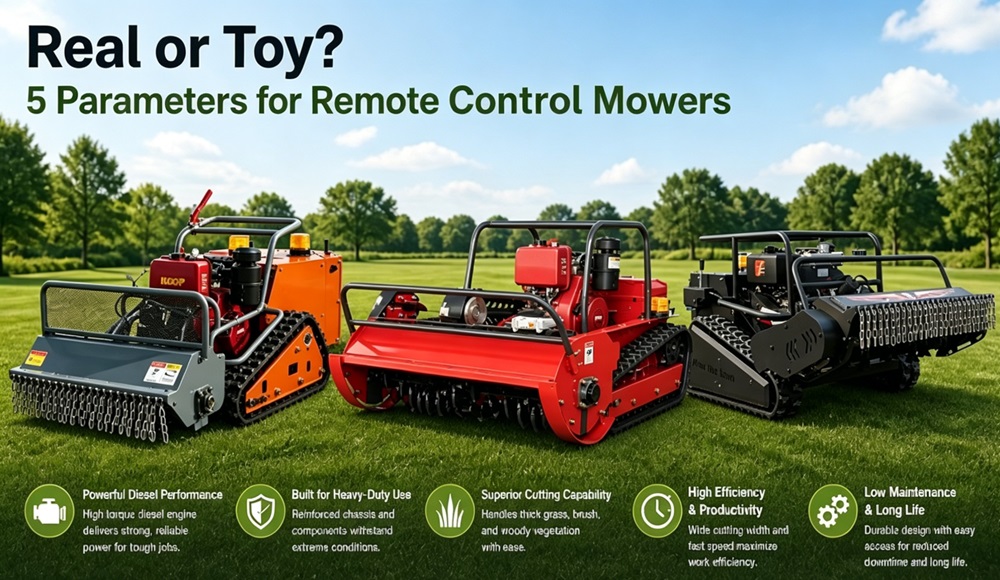
Real or Toy? 5 Parameters for Remote Control Mowers
Introduction: A Booming Market with Hidden Traps
The global market for remote control track mowers has grown rapidly in recent years. From highway embankments to orchards and reservoir dams, more commercial buyers are shifting away from traditional ride-on mowers and manual trimmers toward remote control mowers. The reasons are clear: rising labor costs, tightening safety regulations, and the unacceptable risks of operating on dangerous terrain.
However, this surge in demand has brought a serious problem. The market is flooded with low-quality machines that look professional but perform like toys. As an experienced B2B buyer, you need to separate genuine remote control slope mowers from cheap imitations. This guide walks you through 5 critical parameters to make a smart purchasing decision.
Parameter 1: Remote Control Distance & Signal Reliability
The most obvious difference between a professional remote control mower and a toy-grade machine is the remote system. Many low-end manufacturers claim 300 or even 500 meters, but in real-world conditions, the signal may drop at 100 meters—failing against basic interference like trees or power lines.
A genuine commercial remote control mower must deliver three things: a stable range of at least 500 meters in open areas, frequency-hopping technology to prevent interference when multiple machines operate together, and automatic stop on signal loss—the machine must shut down immediately when the connection breaks, not continue moving.
Buyer’s Checklist: Request a live signal loss demonstration before purchase. Verify frequency-hopping spread spectrum technology. Check for an independent emergency stop button on the remote.
Parameter 2: Slope Climbing Capability & Chassis Design
Slope climbing ability is the single most important performance metric for any remote control slope mower. Yet many manufacturers significantly exaggerate this number. A machine labeled “30 degrees” may struggle on 20-degree wet grass. A genuine commercial machine should achieve at least 40 degrees of actual climbing ability on grass or soil, with premium models reaching 50 degrees or more.
But slope rating alone is not enough. True stability comes from a low center of gravity combined with rubber tracks. Professional machines use a low center of gravity to prevent rollovers and engineering-grade rubber tracks to maximize traction while protecting paved surfaces. Toy-grade machines have higher centers of gravity and narrower tracks, making them dangerous on any slope over 20 degrees.
Buyer’s Checklist: Request video proof of climbing a 40-degree slope. Inspect track material—genuine engineering rubber lasts 3-5 times longer than cheap alternatives. Measure track width; anything narrower than 150mm is a red flag.
Parameter 3: Cutting System Precision & Adjustment Method
A professional remote control mower is not just for rough cutting. Commercial buyers need versatility: mowing golf course rough one day and clearing overgrown embankments the next. The cutting height range tells you everything: 1-5cm for fine turf and formal landscapes, 10-20cm for orchards and routine slope maintenance, and 20-28cm for brush clearing and first-pass mowing. A genuine machine must offer at least 1-25cm of adjustment; toy-grade machines often max out at 10-15cm.
The adjustment method is where quality really separates. Entry-level machines use manual pin adjustment—the operator must stop, walk to the machine, pull pins, and reposition the deck, taking 2-3 minutes each time. Premium machines feature hydraulic lift systems, allowing operators to adjust cutting height in seconds without leaving their remote position. The productivity difference is substantial: roughly 30-45 minutes of additional cutting time per day.
Buyer’s Checklist: Verify the machine can cut at 5cm or lower for fine turf. Confirm maximum cutting height is at least 20cm. Prioritize hydraulic lift over manual pin adjustment for commercial use.
Parameter 4: Dual Drive Motors & Track System
Most buyers never think about drive motor redundancy until a failure happens on a remote slope. By then, it is too late. Professional remote control mowers use dual independent drive motors (typically 1000W each or higher), providing two critical advantages: true zero-turn capability with independent left-right track control, and redundancy—if one motor fails, the second can still drive the machine back to the operator or service point. Toy-grade machines use a single motor with a differential. When that motor fails, the machine is stranded, potentially requiring expensive recovery equipment if stuck on a slope.
Track quality is another hidden operating cost. Poor-quality tracks are among the most common warranty claims on cheap machines. Genuine commercial machines use engineering-grade rubber tracks reinforced with steel or Kevlar cord, lasting 800-1200 hours under normal use. Toy-grade tracks use recycled rubber compounds and begin cracking or delaminating at 200-300 hours—just outside the warranty period.
Buyer’s Checklist: Confirm dual independent motors, not a single motor with differential. Ask about track material and expected lifespan in hours. Request track replacement cost information—this is a major long-term ownership expense.
Parameter 5: Battery System & Logistics Design
This parameter separates professional buyers from casual purchasers. A commercial remote control mower operates in all weather conditions and stores in various environments. Genuine machines feature removable battery packs (typically 24V/45Ah or higher, dual batteries), standard connectors for easy replacement, and weather-resistant battery compartments. Toy-grade machines have integrated, non-removable batteries. This creates serious problems: batteries cannot be moved indoors during freezing temperatures (reducing lifespan by 50% or more), charging requires the entire machine to be near an outlet, and replacement requires professional service.
Dimensions are equally easy to overlook. Many buyers discover only upon delivery that the machine does not fit on a standard pickup truck or through a warehouse door. A commercially viable machine must allow standard pickup transport (length under 1800mm, width under 1300mm), standard pallet storage, and optimized container loading. Dimensions around 1700×1200×800mm fit 95% of standard pickup beds and maximize container utilization.
Buyer’s Checklist: Confirm batteries are removable with standard connectors. Request full dimensions to verify transport and storage requirements. Ask about cold-weather battery storage recommendations.
Frequently Asked Questions
Q: What is the average lifespan of a commercial remote control mower?
A: A genuine remote control slope mower typically delivers 2,000 to 3,000 hours of operation before major component replacement. Toy-grade machines often fail before 500 hours.
Q: How much can I save by switching from manual crews?
A: One remote control mower replaces 3 to 5 manual workers. With typical annual labor costs of $30,000–$50,000 per worker in developed markets, the payback period is often 4 to 8 months.
Q: Is operator training difficult?
A: No. Most operators become proficient within 2 to 4 hours of supervised practice, and the remote keeps them at a safe distance during the learning curve.
Q: What maintenance is required?
A: Standard small-engine maintenance: oil changes every 50-100 hours, air filter cleaning, spark plug replacement, and track tension adjustment. The remote system is maintenance-free under normal use.
Q: Can it handle wet conditions?
A: Yes. Key components are sealed against moisture, and rubber tracks provide superior traction in wet grass or light mud. However, we do not recommend operating in heavy rain or standing water exceeding ground clearance.
Conclusion: The Cost of Choosing Wrong Is Higher Than You Think
The global shift toward remote control track mowers is not a trend—it is a fundamental change in how commercial vegetation management is done. Labor shortages, stricter safety regulations, and the need for year-round productivity are driving this transformation. But choosing the wrong machine brings serious consequences: unexpected downtime from failed components, safety incidents from unstable equipment, hidden operating costs from poor track life and battery replacement, and lost bids because your equipment cannot handle the required slope.
By applying the 5 parameters in this guide—remote reliability, true slope capability, cutting precision, dual-motor redundancy, and logistics-friendly design—you can confidently evaluate any remote control mower and select one that delivers real commercial value.
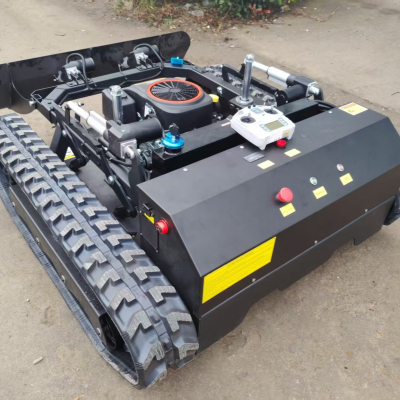
A Machine That Passes All 5 Tests: SH-1100IEC All-Terrain Remote-Controlled Grass Crusher
When measured against these five critical parameters, the SH-1100IEC stands out as a machine built for serious commercial operators—especially those tackling the challenging landscapes of Southern Europe.
Power That Delivers. At its heart is the KOOP295 25HP engine paired with a 2500W generator. This combination provides industrial-grade power that performs reliably under hot summers and through dense, overgrown vegetation. The hydraulic lift system allows remote height adjustment from 1cm to 28cm—no manual cranking, no getting off the machine. For operators maintaining steep terraced fields across Spain, Italy, or Portugal, this means less labor and more done.
Wide Cutting, Fast Coverage. Choose between 1000mm or 1200mm cutting decks. The wider deck not only covers ground faster but also mulches grass clippings evenly across the soil surface, reducing moisture evaporation—an ideal feature for ecological management in olive groves, vineyards, and orchards.
Conquers Steep Slopes Safely. Dual 1000W drive motors and engineering rubber tracks deliver genuine 50° slope climbing capability. With a 500-meter remote control range, operators stay safely away from hazardous inclines. The 0-6 km/h travel speed adapts to all terrain conditions, from gentle orchard floors to steep olive terraces.
Built for Southern European Terrain. This machine is specifically designed for the challenging landscapes of Spain’s slopes, Italy’s hills, Portugal’s mountains, and Slovenia’s rugged terrains. The tracked chassis provides strong traction, ensuring stability without slipping or tipping—conditions where wheeled machines simply cannot operate.
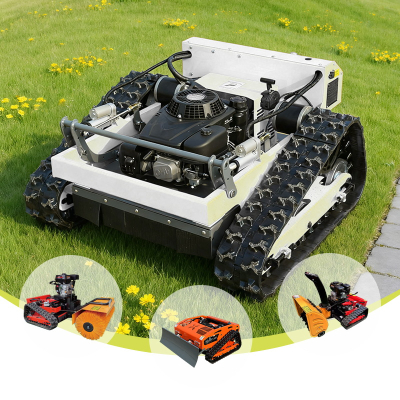
A Year-Round Investment. The SH-1100IEC is not a single-season machine. It supports expandable functions including spraying, cleaning, and snow removal. From spring mowing to winter land clearing, it delivers continuous value throughout the year.
For B2B buyers serving the Mediterranean agricultural market—where steep slopes, summer heat, and dense vegetation are daily realities—the SH-1100IEC offers a combination of power, safety, and versatility that few machines can match.
Contact our export team today for more information.