How to Mow Steep Slopes Safely and Efficiently: A Complete Guide to Remote Control Mowers
Mowing a steep slope is very different from maintaining a flat lawn. Uneven ground, loose soil, wet grass, limited traction, and difficult access can make routine mowing slower, more labor-intensive, and more challenging for operators. For landscaping contractors, property managers, agricultural operators, and vegetation maintenance teams, choosing the right equipment is therefore essential for maintaining both productivity and operating efficiency.
So, what is the best way to mow steep slopes?
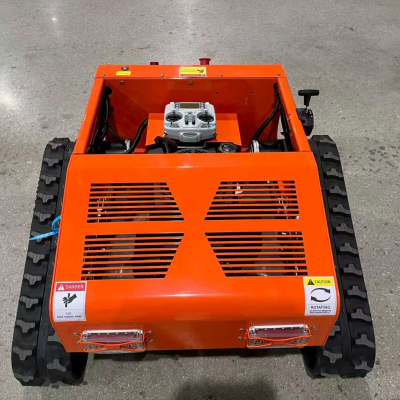
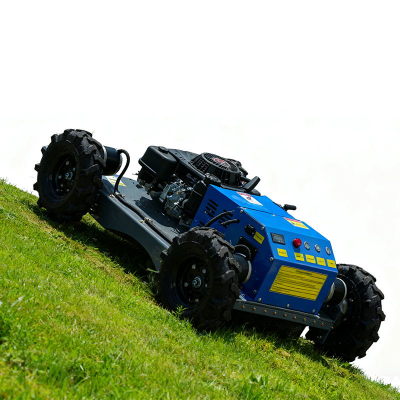
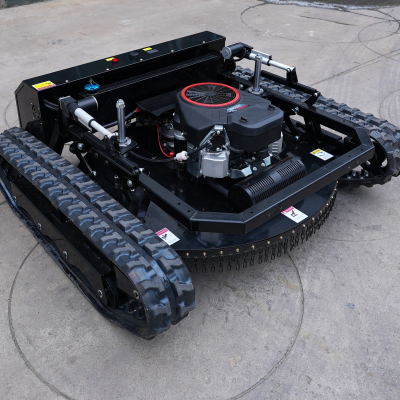
For challenging terrain, a tracked remote control lawn mower can provide a practical alternative to conventional walk-behind and wheeled mowers. By combining remote operation, tracked mobility, and a powerful cutting system, this type of equipment allows the machine to work in difficult areas while the operator controls it from a more suitable position.
Why Is Mowing Steep Slopes So Difficult?
The main challenge of slope mowing is not simply the angle of the terrain. As the slope becomes steeper, maintaining traction and machine stability becomes more difficult. Loose soil, wet grass, mud, rocks, roots, and uneven surfaces can further reduce grip and make conventional wheeled equipment harder to control.
Operator fatigue is another important consideration. With traditional mowing equipment, operators may need to walk behind the machine or drive directly across the slope for extended periods. On large or steep areas, this can increase physical strain while also making the job more time-consuming.
These challenges become even more significant when maintaining roadside slopes, riverbanks, embankments, orchards, construction sites, or large commercial properties. In such environments, the equipment needs to do more than simply cut grass. It needs to provide sufficient traction, stability, maneuverability, and working efficiency.
What Type of Mower Is Best for Steep Slopes?
There is no single mower that is ideal for every terrain. A conventional wheeled mower can still be an excellent choice for flat lawns and moderate slopes. However, when the working environment becomes steeper, rougher, or more difficult to access, a tracked remote control mower can offer several advantages.
A tracked chassis provides greater ground contact than a typical wheeled system, which can help improve traction and stability on uneven surfaces. More importantly, remote operation changes the way the operator interacts with the machine. Instead of continuously walking behind the mower or driving directly across a difficult slope, the operator can control the machine remotely from a more appropriate location.
This combination of tracked mobility and remote operation is particularly valuable when mowing areas where direct operator access is difficult or undesirable.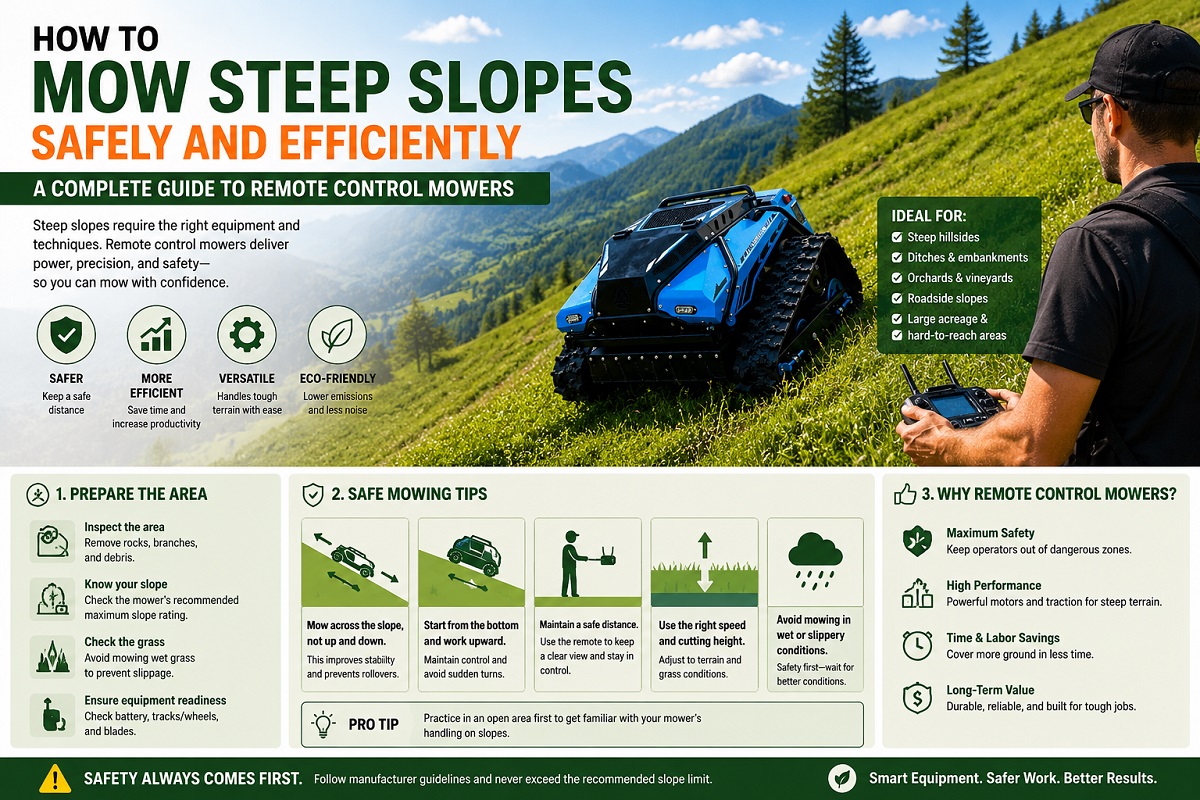
Tracked vs. Wheeled Mowers for Slope Mowing
For relatively flat lawns, wheeled mowers remain a practical and cost-effective option. They are easy to operate and well suited to conventional landscaping applications.
The situation changes when the terrain becomes steep, muddy, uneven, or difficult to access. In these conditions, traction and stability become increasingly important. A tracked remote control mower can distribute its weight across a larger contact area, helping it maintain better contact with the ground while navigating challenging surfaces.
Remote operation also provides an additional advantage. The operator does not have to remain directly behind the machine or physically drive across the slope. This can reduce physical fatigue and provide greater flexibility when working around steep hillsides, roadside vegetation, riverbanks, and other difficult areas.
For businesses that regularly manage complex terrain, the question is therefore not simply whether a tracked mower is better than a wheeled mower. The more important question is which machine is better suited to the actual working environment.
How Does Remote Control Technology Improve Slope Mowing?
The biggest advantage of a remote control lawn mower is the separation between the operator and the machine.
Traditional mowing requires the operator to remain close to the equipment. On a difficult slope, this can mean spending hours walking or driving across uneven terrain. With remote control technology, the operator can remain outside the immediate mowing area while controlling the machine from a suitable position.
This can make a significant difference when working on steep slopes or near potentially hazardous areas. It also reduces the need for operators to continuously walk across difficult terrain, which can help reduce fatigue during long working periods.
However, remote operation does not remove the need for proper safety procedures. Actual operating conditions depend on slope angle, ground surface, weather, vegetation, obstacles, machine specifications, and operator experience. The working area should always be assessed before operation.
How Steep of a Slope Can a Remote Control Mower Handle?
One of the first specifications buyers should examine is gradeability.
Gradeability indicates the maximum slope a machine is designed to negotiate under specified conditions. However, it should not be viewed as an absolute guarantee of performance in every environment.
A mower's actual ability to work on a slope can also depend on ground conditions, soil moisture, grass height, traction, machine weight, track design, load, and operating technique. A machine may perform very differently on dry grass compared with wet mud, even on the same slope.
For this reason, buyers should evaluate gradeability together with the actual conditions of their job sites rather than focusing only on the highest advertised number.
What Should You Consider When Choosing a Remote Control Slope Mower?
For commercial users, choosing the right machine requires looking beyond the basic purchase price.
Gradeability and track design are particularly important for steep terrain because they influence how effectively the machine can maintain traction and stability. The cutting width should also match the working area. A wider cutting deck can improve productivity on large open spaces, while a more compact cutting system may be easier to maneuver around trees, fences, and narrow areas.
The power system is equally important. Engine output and drive motor performance affect the machine's ability to cut dense vegetation and move across demanding terrain. Buyers should also consider the remote control range, especially when working across large properties or areas where the operator needs to maintain a greater distance from the machine.
Finally, long-term support should not be overlooked. For professional users, spare parts availability, warranty coverage, technical support, and maintenance services can have as much impact on the total cost of ownership as the initial purchase price.
Where Can Remote Control Slope Mowers Be Used?
The potential applications extend well beyond residential lawns.
Roadside slopes are one example. Vegetation along roads can be difficult to maintain because of limited access and the proximity of traffic. A remote control mower can work within the vegetation area while allowing the operator to remain in a more suitable position.
Riverbanks and embankments present similar challenges. These areas often combine steep slopes, uneven surfaces, and tall vegetation, making conventional mowing equipment less convenient.
Agricultural applications are another growing area. Orchards and farms can contain uneven ground, narrow passages, and dense vegetation. A compact tracked mower can provide greater accessibility while reducing the need for operators to work directly on difficult terrain.
For landscaping contractors and property management companies, remote control mowers can also be used for parks, large commercial properties, industrial facilities, construction sites, and other areas where conventional equipment may be less efficient.
Solar farms are another potential application. Vegetation around solar installations requires regular maintenance across large areas, and the combination of remote operation and tracked mobility can be useful when the terrain is uneven or difficult to access.
Can Remote Control Mowers Reduce Labor Costs?
Labor efficiency is one of the main reasons commercial users are becoming interested in remote mowing technology.
Traditional mowing operations can require multiple workers depending on the size of the site, terrain, vegetation, and equipment being used. A remote control mower allows a trained operator to control the machine without continuously walking behind it or driving directly across difficult terrain.
The actual labor savings will vary from one application to another, but reducing physical workload and improving machine productivity can help landscaping businesses make better use of their workforce.
For contractors, it is therefore worth looking beyond the initial question of “How much does a remote control mower cost?”
A more useful question is:
“How much time, labor, and operating effort can the right mower save over its working life?”
This approach provides a more realistic way to evaluate the return on investment of commercial mowing equipment.
How to Choose the Right Remote Control Mower for Your Business
Before purchasing a remote control mower, start with the job site rather than the machine.
Consider the steepest areas you need to maintain, the type of ground surface, the average mowing area, and the type of vegetation you encounter. A machine working on dry grass and gentle slopes will have very different requirements from one working on wet hillsides covered with dense vegetation.
It is also important to consider how the mower will fit into your existing workflow. Look at your current labor requirements, average working hours, mowing frequency, transportation needs, maintenance resources, and expected operating life.
Once these factors are clear, you can compare machines based on gradeability, track system, cutting width, power, remote control range, cutting-height adjustment, maintenance requirements, and after-sales support.
A Practical Solution for Challenging Terrain
For contractors and professional users who regularly face difficult mowing conditions, a tracked remote control lawn mower can provide a combination of terrain adaptability, remote operation, productivity, and operator convenience.
The SAAO SAG600 Hybrid Remote Control Lawn Mower, for example, is designed for demanding mowing applications. Its tracked chassis and gradeability of up to 50° make it suitable for challenging terrain, while its remote-control system allows the operator to control the machine from a distance.
The SAG600 features a 600 mm cutting width, a 9.5 HP Loncin engine combined with a 2,200 W generator, and remote-controlled cutting-height adjustment. These features are designed to support applications where conventional lawn mowers may struggle to maintain productivity.
For landscaping contractors, slope maintenance teams, agricultural users, and commercial vegetation management companies, a machine with this combination of mobility and remote operation can provide a practical way to approach difficult mowing projects.
Final Thoughts
Mowing steep slopes efficiently is not simply about choosing a more powerful lawn mower. It is about selecting equipment that matches the terrain, vegetation, working conditions, and operational requirements of the job.
For flat lawns, conventional wheeled mowers may remain the most practical choice. But when the work involves steep slopes, uneven terrain, large commercial properties, roadside vegetation, orchards, embankments, or other difficult areas, tracked remote control lawn mowers can provide a more flexible solution.
When evaluating a machine, look beyond the purchase price. Consider its gradeability, traction, cutting width, power system, remote control range, operating efficiency, maintenance requirements, and after-sales support.
The right equipment can help landscaping businesses reduce labor pressure, improve productivity, and take on mowing projects that are difficult to handle with conventional equipment.
Looking for a remote control lawn mower for steep slopes or commercial landscaping? Contact SAAO to discuss your terrain, mowing requirements, and equipment options.