Are Electric Lawn Mowers Worth It?
Global sales data reveals a decisive answer: yes, for most users. The electric lawn mower market is experiencing explosive growth, projected to surge from an estimated USD 10.7 billion in 2025 to USD 14.6 billion by 2030, growing at a robust 6.4% compound annual rate. A separate analysis values the 2024 market at USD 10.25 billion, forecasting it to reach USD 15.71 billion by 2030 with a 7.37% CAGR. The question is no longer if electric mowers are viable, but which model best fits your specific needs.
Consumer behavior firmly supports this trend. In 2024, residential DIY owners generated 68.1% of total demand, while municipal procurement surged at an accelerated pace as public agencies replace gasoline fleets with zero-emission alternatives.
Performance: Power vs. Convenience
Performance expectations for electric mowers have shifted dramatically. Lithium-ion battery pack prices dropped from USD 140 per kWh in 2023 to a projected USD 86 per kWh by 2035, while advanced cell chemistries deliver 15–20% density gains, enabling walk-behind cordless mowers to run 45–60 minutes on a single charge.
However, gas mowers maintain an edge in sustained power delivery for very tall, dense grass. Commercial battery zero-turn models list at USD 15,000–25,000 versus USD 8,000–12,000 for gasoline units.
Consumer sentiment analysis reveals that cordless convenience (20.7%) and lightweight design (13.1%) drive positive feedback, while short battery life (31.7%) remains the top complaint.
Cost Analysis: Higher Upfront, Lower Long-Term
Upfront cost remains the primary barrier: battery walk-behind mowers typically range from $300 to $1,000, while most gas models fall under $500. However, five-year ownership costs tell a different story.
For homeowners who mow an average of 70 hours annually, a gas mower consumes approximately 17.5 gallons of fuel per year. At current fuel prices, annual operating costs (fuel, oil, maintenance) are significantly higher for gas mowers compared to the low electricity costs of battery-powered models.
Over five years, total ownership costs clearly favor electric mowers, with potential savings of 40–50% for electric owners. John Deere’s go-to-market manager confirms: “Over time, electric mowers often prove more economical due to no fuel costs and lower maintenance and repair costs.”
Environmental Impact: A Clear Winner
Gas-powered lawn equipment contributes approximately 5% of U.S. CO- emissions annually, with a single gas mower operating for one hour emitting as much smog-forming pollution as driving a car for 45 miles. Battery mowers produce zero direct emissions, with 60% quieter operation than gas models.
Walk-behind cordless units led the market with 41.3% of 2024 revenue, while robotic and autonomous systems recorded a brisk 15.1% CAGR outlook to 2030.
Runtime: Unlimited vs. Battery-Limited
Typical gas mower runtime: 45–90 minutes per tank. Cordless models: 45–60 minutes per charge. Battery pack life now extends to 5–7 years under advanced thermal management, pushing total operating cost below gasoline equivalents once routine maintenance is removed.
Maintenance: Simplicity vs. Complexity
Electric mowers eliminate oil changes, spark plugs, air filters, and carburetor issues. Gas mowers demand regular attention: annual service over a decade results in high ongoing maintenance costs, excluding major repairs such as crankshaft or engine replacements.
Which One Should You Choose?
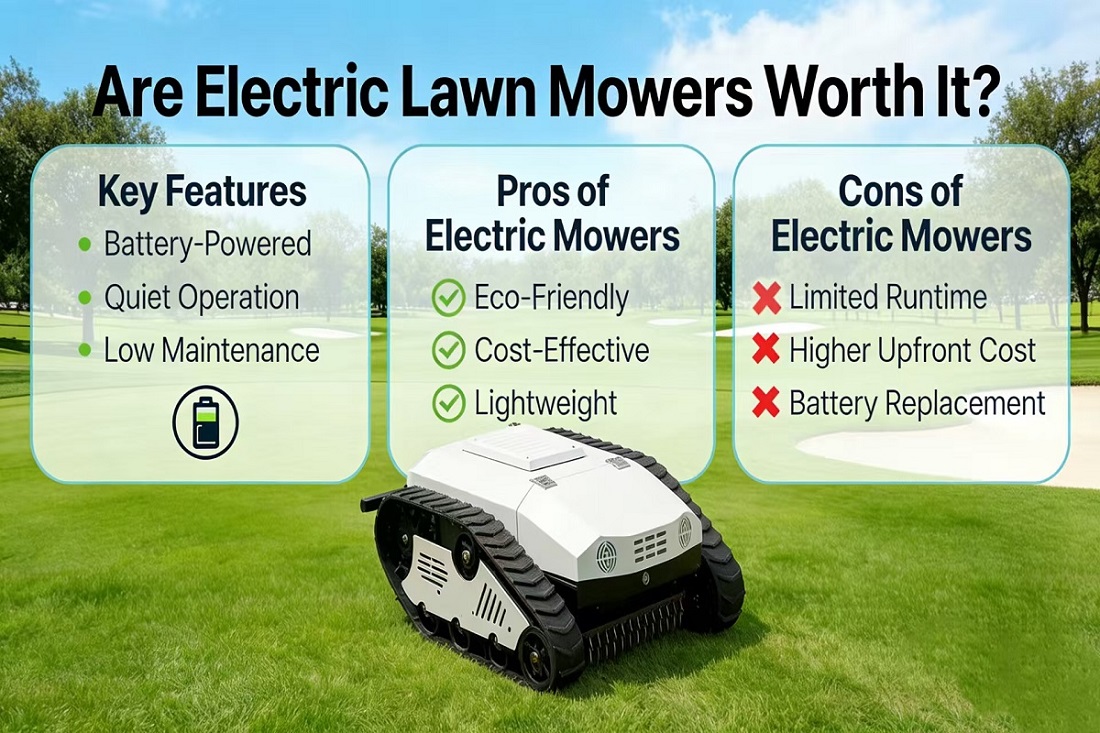
Choose electric if:
· Your lawn is under 1 acre (or you're willing to swap batteries)
· You prioritize convenience, low maintenance, and quiet operation
· Environmental impact matters to you
· You want push-button start every time
Choose gas if:
· You have a very large property (over 1 acre) with thick, wet grass
· Your property has steep slopes (over 15 degrees)
· Upfront cost is your primary concern and you're comfortable with ongoing maintenance
· You already have gas infrastructure and prefer traditional power
The Hybrid Alternative: SAAO’s Approach
Hybrid technology is projected to capture 25% of the lawn mower market by 2026. SAAO’s hybrid remote controlled mowers — SH-800DL and SH-1100IEC — combine diesel engines with builtin generators and electric drive systems, delivering unlimited runtime, instant torque, and no belts for reduced maintenance.
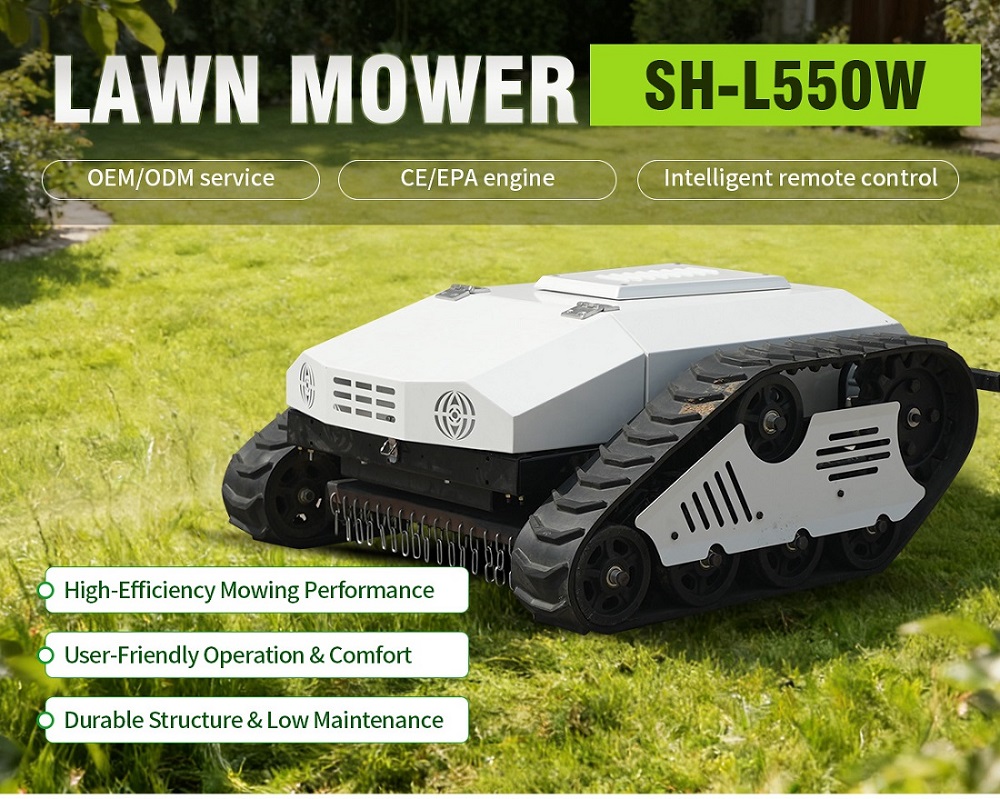
Spotlight: SAAO Lithium-Ion Battery Mower
For those ready to go fully electric today, SAAO offers a purpose-built lithium-ion mower that combines professional power with zero-emission operation. Its key specifications demonstrate why electric is no longer a compromise.
Compact & Portable
Machine dimensions: 98 cm (L) × 88 cm (W) × 42 cm (H) — fits easily into most storage spaces and trailers.
Total machine weight: 96 kg (including battery, remote, and cutting system) — heavy enough for stability yet light enough for one person to move with a trailer ramp.
Battery weight: 15.5 kg — removable for convenient charging or swapping.
Export-ready crate: 109×94×60 cm fumigation-free wooden box with hinged lid (easy customs inspection), reinforced top panel for stacking, and forklift slots on all four sides. Gross weight: 130 kg.
Powerful Electric Drivetrain
Cutting power: 2000W brushless mowing motor (max speed 75 r/min) + two 350W brushed travel motors.
Cutting width: 550 mm (adjustable height from 20 mm to 70 mm via remote control).
Travel speed: 0–3 km/h, infinitely variable with high/low speed switching.
Remote range: Up to 200 meters — ideal for slopes and obstacle-rich areas.
Ground clearance: 100 mm — navigates uneven terrain without scraping.
Long-Lasting Battery System
Battery type: High-rate lithium-ion, certified for hazardous goods transport (UN38.3 etc.).
Discharge current: Max 80A — sustained power for thick grass.
Charger: Three-stage smart charger, total charging time ≈7 hours.
Operating time: Sufficient for typical residential lawns under 1 acre (exact runtime varies with terrain and speed).
Safety & Convenience
Remote electric height adjustment — change cutting height without leaving your seat.
Certified export packaging — meets international air/sea freight regulations.
2-year warranty on core components, backed by SAAO’s 20 years of manufacturing expertise.
This model bridges the gap between lightweight residential mowers and heavy commercial diesel units. It’s ideal for homeowners with medium to large yards, as well as for municipal parks and orchards where quiet, emission-free operation is required.
The Bottom Line
The electric lawn mower market is projected to reach USD 15.71 billion by 2030 at a 7.37% CAGR, with walk-behind cordless models capturing 34.7% global share and residential DIY users accounting for a dominant 54.1% segment share. Municipalities are accelerating electric adoption at 14.2% CAGR as they replace gasoline fleets. North America maintains the largest regional base with 35.2% share, while Asia-Pacific emerges as the growth engine at 11.1% CAGR.
For the vast majority of homeowners with small to medium-sized lawns (under 1 acre), a modern cordless electric mower offers superior convenience, lower long-term costs, quieter operation, and zero direct emissions — without sacrificing cutting performance. The question is no longer “if” to switch, but “when.”
Still unsure which mower is right for your property? The SAAO team can help you match the perfect machine to your specific lawn size, terrain, and budget — whether that’s a quiet cordless electric model for a residential yard or a powerful hybrid remote controlled mower for commercial applications.